

Table of Contents
- PS5 Pro vs PS5 Slim: Specs and Hardware Architecture Compared
- PS5 Pro Performance Benchmarks 2026: Frame Rate and Visual Fidelity
- Is PS5 Pro Worth It for 1080p Gamers?
- Best Gaming Monitor for PS5 Pro: Refresh Rate and Display Output
- What Competitors Miss: Power Consumption, Legacy Peripherals, and TCO
- Which PS5 Should You Buy in 2026?
- Frequently Asked Questions
Last Updated: September 27, 2026
PS5 Pro vs PS5 Slim: Specs and Hardware Architecture Compared
The PS5 Pro vs PS5 Slim comparison starts with one hard truth: both consoles play the same games, but they are built for different buyers. The PS5 Pro targets players who want maximum visual fidelity and stable frame rates. The PS5 Slim targets players who want the full PS5 library in a smaller, lighter box. The spec sheet only tells half the story.
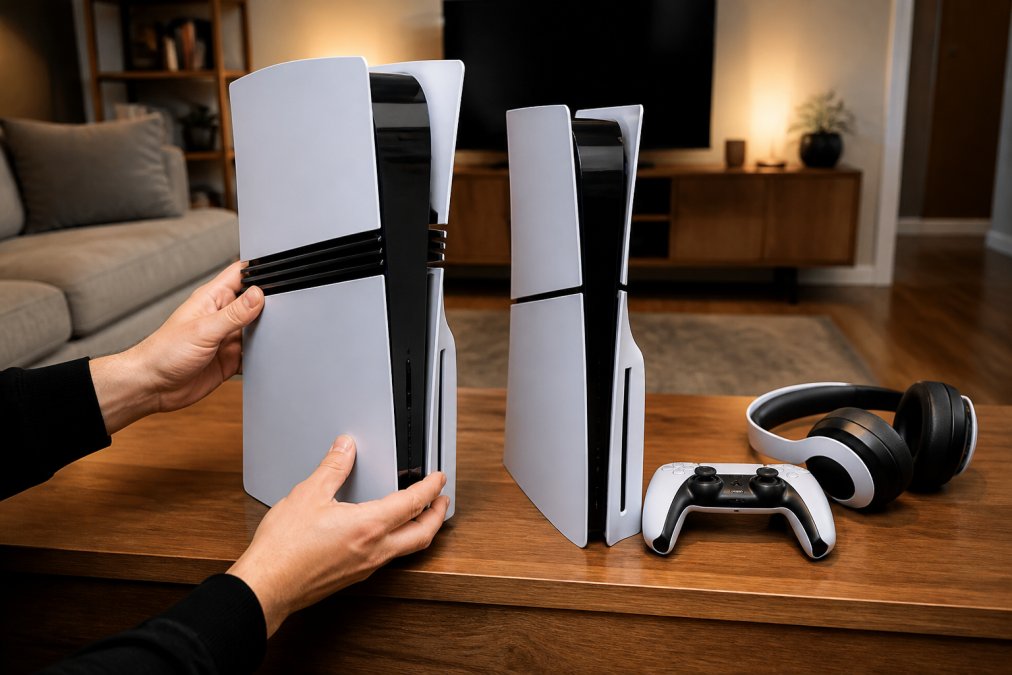
GPU Compute Units, Memory Bandwidth, and Internal Board Layout
The PS5 Pro's biggest upgrade sits in its GPU. It carries more compute units and wider memory bandwidth than the PS5 Slim, which lets it push higher native resolutions and more demanding graphical presets. The internal board layout also differs: the Pro runs a larger mainboard to support the extra silicon, while the Slim's board is tightly packed to fit its smaller shell.
Cooling Circuits, Fan Noise, and Power Draw
Cooling is where the two consoles diverge most in daily use. The PS5 Pro runs a larger heatsink and revised cooling circuits to handle its higher power draw. The PS5 Slim uses a more compact thermal design. In practice, the Slim runs quieter under light loads, while the Pro's fan becomes more audible during long sessions with ray tracing enabled.
| Spec Area | PS5 Pro | PS5 Slim |
|---|---|---|
| GPU compute units | Higher count | Standard count |
| Memory bandwidth | Wider | Standard |
| Internal SSD | Larger capacity | Standard capacity |
| Cooling design | Larger heatsink | Compact thermal design |
| Power draw | Higher | Lower |
| Best for | Max fidelity, 60 fps | Value, smaller setup |
PS5 Pro Performance Benchmarks 2026: Frame Rate and Visual Fidelity
PS5 Pro performance benchmarks in 2026 come down to one question: does the extra hardware actually change how games look and run? For most titles, yes, but the gap is narrower than the marketing suggests. The Pro's advantage shows up most in ray tracing performance and dynamic scaling, where it holds a steadier frame rate when the action gets heavy.
Locked 60 FPS, Ray Tracing Performance, and Dynamic Scaling
A locked 60 fps is the goal for most performance modes, and the PS5 Pro hits it more consistently in demanding scenes. Dynamic scaling, which adjusts resolution on the fly to protect frame rate, kicks in less often on the Pro because it has more headroom. Ray tracing performance improves too, letting more games run reflections and lighting effects without dropping frames.
- Titles with a dedicated Pro patch and a 60 fps performance mode are where the Pro pulls ahead most. Games like Marvel's Spider-Man 2, Ratchet & Clank: Rift Apart, Horizon Forbidden West, Gran Turismo 7, and The Last of Us Part II Remastered ship with Pro-specific modes that raise internal resolution, add ray-traced reflections or shadows, or hold a tighter frame rate in performance mode. In these titles, the Slim typically runs the standard PS5 performance mode (often a dynamic 1440p-class image upscaled to 4K), while the Pro runs a higher internal resolution with the same 60 fps target.
- Titles with a Pro patch but no performance-mode changes mostly gain image clarity, not frame rate. You get a sharper 4K presentation and less aggressive dynamic resolution scaling, but the frame rate target is unchanged.
- Titles with no Pro patch at all run in their standard PS5 mode on both consoles. The Pro's extra hardware sits largely idle. This is the group most buyers underestimate, a meaningful share of the back catalog and smaller releases fall here.
- CPU-bound titles, large simulation-heavy games and some 120 fps modes, see little to no gain on the Pro, because the CPU is the same architecture class as the Slim's.
SSD Throughput and Load Times
Is PS5 Pro Worth It for 1080p Gamers?
For 1080p gamers, the PS5 Pro is usually not worth the extra cost. The Pro's advantages, higher native resolution, better ray tracing, and steadier frame rates, matter most on a 4K display. On a 1080p screen, the PS5 Slim already delivers smooth performance in most games, and the Pro's extra GPU power often goes unused. If you play on a 1080p monitor and don't plan to upgrade, the Slim is the smarter buy.
Best Gaming Monitor for PS5 Pro: Refresh Rate and Display Output
The best gaming monitor for PS5 Pro is a 4K panel with a high refresh rate and HDMI 2.1 support. That combination lets the console output its full resolution at high frame rates, which is where the Pro's hardware actually pays off. A 120Hz panel with variable refresh rate support keeps motion smooth and reduces screen tearing during dynamic scaling.
Upscaling Technology and Image Enhancement
Upscaling technology is central to how the PS5 Pro delivers image enhancement. It renders games at a lower internal resolution, then uses hardware upscaling to output a sharper image at 4K. This keeps frame rates high without sacrificing visual fidelity. The result: games look close to native 4K while running smoother than they would at full native resolution. On the PS5 Slim, upscaling is present but less aggressive, so image enhancement gains are smaller.
What Competitors Miss: Power Consumption, Legacy Peripherals, and TCO
Most comparisons stop at specs and skip the practical stuff. This section is where the real ownership math lives, and it's the part almost no ranking article covers.
Long-Term Power Consumption and Heat
Power draw matters twice: once on your electricity bill and once as heat in the room. The PS5 Pro draws more watts than the Slim under load because of its larger GPU and higher clocks, and that gap widens during ray-traced or high-frame-rate sessions. The practical consequences over two or more years of use:
- Electricity cost. Your bill depends on your local utility rate and how many hours you play. A higher-wattage console running several hours a week costs measurably more per year than a lower-wattage one, the difference is small per session but compounds across a console's lifespan. Check your utility's rate per kilowatt-hour and multiply by your weekly hours to estimate your own number.
- Heat and room temperature. A console drawing more watts dumps more heat into the room. In a small, poorly ventilated space, that's noticeable during long sessions, and it's why the Pro's larger heatsink and revised airflow exist in the first place.
- Fan noise over time. Dust buildup degrades cooling performance on both models. The Pro's higher thermal load means its fan works harder from day one, so cleaning the vents and keeping the console off carpet matters more on the Pro than the Slim.
Legacy Peripherals and Accessories
Both consoles support the same DualSense controller, the same Pulse headset family, and the same PlayStation VR2 headset, the Pro does not require new peripherals. Where owners get tripped up:
- External USB drives. PS4 games can run from a compatible USB external drive on both consoles. PS5 games cannot, they must live on the internal SSD or an installed M.2 NVMe drive. This is identical on Pro and Slim, but it's the single most common storage misunderstanding.
- Older headsets and third-party controllers. Most PS4-era accessories work, but some require a firmware update or a USB dongle to connect reliably. Behavior is the same across both models, so this isn't a reason to pick one over the other, it's a reason to check your specific accessory before you assume it'll just work.
- The disc drive. This is the real peripheral story. The Slim is sold in both a disc and a digital edition, and the digital edition can add a disc drive later. The Pro ships as a digital-only console, with the disc drive sold separately. If you own physical discs or buy used games, that's an added cost on the Pro that the disc-edition Slim includes up front.
Total Cost of Ownership (TCO)
TCO is the number that actually decides this comparison, and it's the one competitors skip. Build it in four lines:
- Console price. The Pro carries a higher sticker price than either Slim configuration.
- Disc drive. Add the standalone disc drive if you buy physical media, required on the Pro, included on the disc-edition Slim.
- Stand. A vertical stand is sold separately on the Slim and is worth budgeting for if you stand the console up.
- Storage expansion. If you install an M.2 NVMe drive, the cost is the same on both models, but the Pro's larger stock drive may delay that purchase.
PlayStation official support page on M.2 SSD expansion requirements
Which PS5 Should You Buy in 2026?
Buy the PS5 Pro if you own a 4K 120Hz display and want the best ray tracing performance and steadiest frame rates. Buy the PS5 Slim if you play on a 1080p screen, want a smaller setup, or care more about value than maximum visual fidelity. Neither is a bad choice; they're built for different priorities. Match the console to your display and your budget, and you'll be happy either way.
Frequently Asked Questions
Is it worth upgrading to a PS5 Pro in 2026?
It depends on your display and how much you notice frame rate drops. The PS5 Pro targets higher and more stable frame rates, better ray tracing performance, and sharper image enhancement through upscaling technology. If you already own a PS5 Slim and play on a 1080p screen, the gains are smaller and harder to justify. If you have a 4K 120Hz display or want the strongest visuals Sony offers, the upgrade makes more sense. Check The Techie Den for current bundles before deciding.
Is there a huge difference between PS5 Slim and PS5 Pro?
No, the difference is real but not dramatic. Both run the same games, use the same SSD storage expansion options, and support the same controllers. The PS5 Pro adds more GPU compute units, higher memory bandwidth, and improved ray tracing performance, which shows up as steadier frame rates and cleaner visual fidelity in supported titles. The PS5 Slim is smaller, quieter in some setups, and cheaper. For most casual players, the Slim covers everything they need.
Do I need a 120Hz display to see the benefits of the PS5 Pro?
Not strictly, but a 120Hz panel with variable refresh rate is where the PS5 Pro makes the most sense. On a 60Hz screen you still get better system stability and fewer dropped frames, but you lose the higher refresh rate headroom the console is built for. If you are shopping for a display, look for 4K resolution, HDMI 2.1, and VRR support. The best gaming monitor for PS5 Pro pairs those specs with low latency for competitive play.
Which PS5 model is best for 4K gaming in 2026?
The PS5 Pro is the stronger pick for 4K gaming because it pushes higher native resolution more often and relies less on dynamic scaling to hold frame rates. The PS5 Slim still outputs 4K and handles most titles well, but demanding games may drop resolution or frame rate to stay smooth. If 4K is your priority and your budget allows it, the Pro is the better long-term upgrade path. If you mostly play at 1080p, the Slim is the smarter buy.
Choosing between the PS5 Pro and PS5 Slim comes down to your display and your budget, and getting it wrong means paying for power you won't use. At The Techie Den, we stock gaming consoles and the accessories that complete the setup, from high-performance gaming peripherals to reliable charging and connectivity solutions. Browse our collection to find the console and gear that match how you actually play, and get started with The Techie Den today.


