

Last Updated: October 28, 2026
Quick Summary
Liquid cooling is not automatically better than air cooling for gaming; the right choice depends on your CPU, your case, and how you measure value. Air cooling is described as reliable and cost-effective but gets louder as hardware power rises, while AIO liquid coolers improve CPU temperatures.
- Air coolers dump heat directly into the case, so case airflow does the heavy lifting.
- AIOs move heat to a radiator at the case edge, which can exhaust it straight out.
- Temperature comparisons only mean something when you control for CPU power draw and ambient room temperature.
- Air coolers need dust clearing every few months; AIOs also need a listening check for pump rattle.
- Do not size a cooler by TDP alone; check reviews that measure the specific CPU you plan to use.
Table of Contents
- Liquid Cooling vs Air Cooling for Gaming: The Short Answer
- Air Cooler vs AIO Cooler: How Each One Handles Heat
- AIO Liquid Cooler vs Air Cooler Temperatures Under Sustained Load
- Noise, Fan Speed, and What You Actually Hear While Gaming
- Cost, Installation, and Case Clearance: The Practical Trade-Offs
- CPU Cooler Reliability and Lifespan: Leak Risk, Pump Wear, and Maintenance
- Choosing the Best CPU Cooler for Gaming by Build Tier
- Match Your Cooler to Your Case and Gaming Setup
- Frequently Asked Questions
Liquid Cooling vs Air Cooling for Gaming: The Short Answer
Liquid cooling is not automatically better than air cooling for gaming, and the honest answer depends on your CPU, your case, and how you measure value. Air cooling is often described as simpler, while liquid cooling can offer different thermal performance and aesthetics. A 2026 EKWB guide characterizes air cooling as reliable and cost-effective, noting it gets louder as hardware power rises, while AIO liquid coolers improve CPU temperatures. That single trade-off explains most of the debate.
Below, we discuss how each cooler handles heat and temperatures under sustained load.
Air Cooler vs AIO Cooler: How Each One Handles Heat
An air cooler is a heat sink and fan assembly that pulls heat from the CPU through metal fins and pushes it into your case, where case fans exhaust it. An AIO cooler (all-in-one liquid cooler) moves heat through a pump, along tubes, and into a radiator, where fans dissipate it.
The mechanical difference matters more than the marketing. Air coolers dump heat directly into the case, so case airflow does the heavy lifting. AIOs move heat to a radiator mounted at the case edge, which can exhaust it straight out.
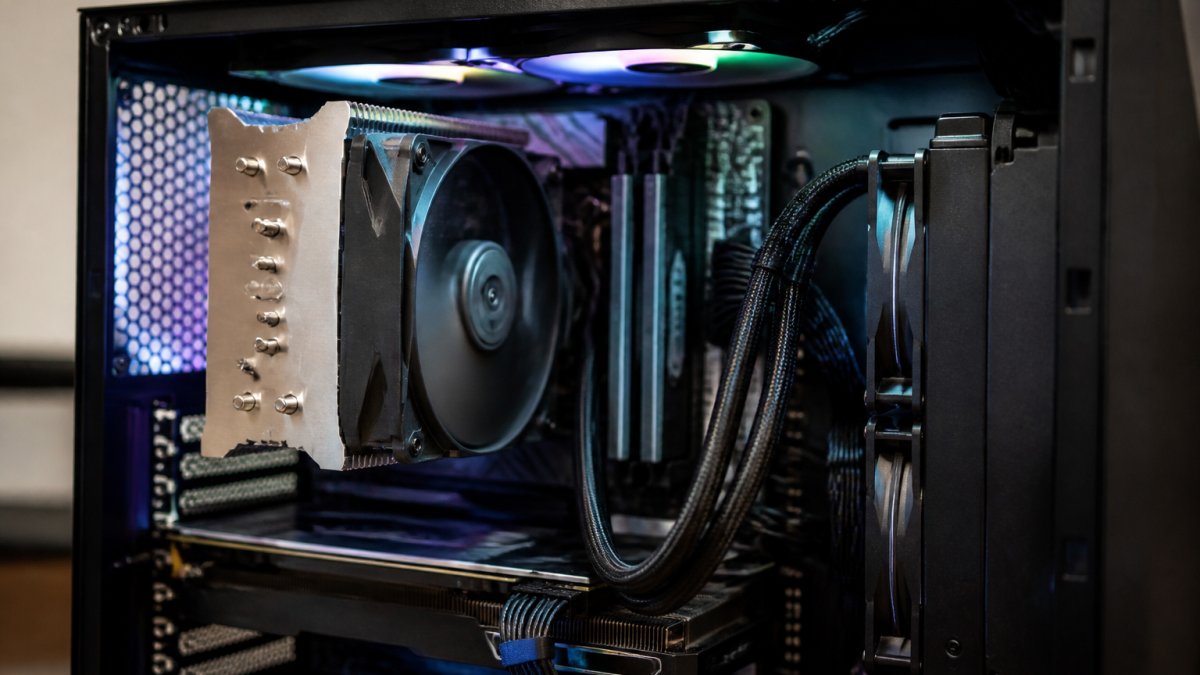
That distinction drives everything else: noise, clearance, failure risk, and how well each option handles a hot GPU sitting right below the CPU.
AIO Liquid Cooler vs Air Cooler Temperatures Under Sustained Load
The U.S. Department of Energy's Federal Energy Management Program evaluated liquid versus air cooling at the Maui High Performance Computing Center to verify cooling efficiency against the site's previous air-cooled system. The published summary does not state the measured outcome, so treat it as a framework for how these comparisons are run, not a gaming benchmark.
Noise, Fan Speed, and What You Actually Hear While Gaming
Noise is where spec sheets mislead. A cooler's rated decibels tell you almost nothing about what you hear at your desk, because fan speed, pump noise, and ambient temperature all shift the result. If you are also weighing peripherals, our gaming keyboard vs regular keyboard comparison covers the key differences.
Cost, Installation, and Case Clearance: The Practical Trade-Offs
| Factor | Air Cooler | AIO Liquid Cooler |
|---|---|---|
| Upfront cost | Lower | Higher |
| Installation | Simple, tool-light | More steps, tube routing |
| Case clearance | Height and RAM limits | Radiator and tube space |
| Sustained-load thermals | Good, hits a ceiling | Stronger headroom |
| Noise character | Fan ramp under load | Fan plus pump hum |
| Failure risk | Fan failure only | Pump wear, leak risk |
| Maintenance | Dust cleaning | Dust plus pump monitoring |
CPU Cooler Reliability and Lifespan: Leak Risk, Pump Wear, and Maintenance
Maintenance differs too. Air coolers need dust clearing every few months. AIOs need radiator cleaning plus a listening check for pump rattle. Neither is hard; one is easier to forget.
Choosing the Best CPU Cooler for Gaming by Build Tier
If you are mapping the cooler into a full build, our high performance gaming setup guide shows how cooling fits the rest of the components. Casual players weighing a simpler path can start with our gaming setup guide for casual players.
Match Your Cooler to Your Case and Gaming Setup
If your desk setup is part of the plan, a case with proper CPU storage and ventilation space helps; our wooden table with CPU storage shelf keeps the tower off the floor and in clean air. Planning a wider display arrangement? Our guide to multi-monitor setups for productivity vs gaming covers how the rest of your desk affects thermals and cable routing.
Frequently Asked Questions
Is liquid cooling better than air cooling for a gaming PC?
It depends on the CPU and workload. A 2026 EKWB guide notes that AIO liquid coolers improve CPU temperatures, while air cooling stays reliable and cost-effective. A 2026 Magic Micro guide recommends air cooling for mainstream gaming builds and liquid cooling for flagship CPUs and demanding workloads. For most mid-range gaming rigs, a good air cooler keeps temperatures in check; step up to liquid cooling when you run a high-end processor under sustained load or overclock.
Does liquid cooling improve gaming performance?
Liquid cooling does not raise frame rates directly. What it can do is keep a high-end CPU below its thermal limits so it avoids thermal throttling during long gaming sessions. If your processor already runs cool with an air cooler, switching to liquid cooling will not add FPS. The gain shows up on flagship processors with high CPU power draw, where better heat dissipation protects sustained performance and system stability.
Is an AIO cooler quieter than an air cooler?
Not automatically. Air coolers get louder as hardware power increases, per EKWB's 2026 guide, but AIOs add pump noise on top of fan noise. A large air cooler with low fan speed can be quieter than a small AIO working hard. Acoustic performance depends on radiator size, fan quality, and how much heat the CPU produces. Check reviews that measure noise levels under sustained load rather than trusting the label.
Are air coolers more reliable than liquid coolers?
Air coolers have fewer failure points: a heat sink and a fan, with no pump or coolant. AIOs add a pump, tubing, and fittings, which introduces leak risk and pump wear over the cooler's lifespan. Asetek describes air cooling as simpler and more cost-effective, while liquid cooling's edge is thermal performance. A quality AIO can last years, but air cooling remains the lower-risk choice for a budget build or a system you rarely open.
The real challenge is not picking a cooler. It is matching cooling to your CPU, case, and noise tolerance without overspending on hardware you will never stress. At The Techie Den, we stock the gaming peripherals and accessories that complete a build, from precision-engineered gaming mice to reliable charging and connectivity gear. Browse our gaming accessories, check current availability, and add to cart to finish your setup with parts that hold up.


