

Table of Contents
- Quick Comparison: Top 4K Gaming Consoles for 2026
- How to Choose a 4K Gaming Console: Key Specs That Matter
- 4K Gaming Monitor vs TV for Consoles: Which Screen Wins?
- How to Optimize Console Settings for 4K HDR
- Best HDMI 2.1 Cables for 4K 120Hz Gaming
- Storage, Peripherals, and Power: The Hidden Costs of 4K Gaming
- Frequently Asked Questions
Last Updated: September 16, 2026
Quick Comparison: Top 4K Gaming Consoles for 2026
The best next gen console for 4K gaming 2026 comes down to three things: native 4K output, HDMI 2.1 bandwidth, and whether you want a traditional console or a flexible media box.
Quick Picks:
- Best for 4K media and streaming: Zidoo Z9X 8K with HDMI 2.1 and Amlogic S928X-K processing
- Best for retro and 4K upscaling on a budget: Intel N100 Game PC Box with dual Windows 11 Pro and Batocera 40
- Best for pure retro libraries: 12TB Gaming HDD with 86,000+ games
- Best for controller flexibility: Mayflash Magicboots X and Haute42 Cosmox Booter X adapters
| Option | Price | 4K Output | Best For |
|---|---|---|---|
| Zidoo Z9X 8K | $418.99 | HDMI 2.1, 8K ready | Media playback and streaming |
| Intel N100 Game PC Box | $412.99 | UHD output | Retro plus modern 4K |
| Video Game Console 2T HDD | $507.99 | UHD output | All-in-one retro setup |
| 12TB Gaming HDD | $297.99 | Requires host PC | Massive retro libraries |
How to Choose a 4K Gaming Console: Key Specs That Matter
Four specs decide whether a console delivers real 4K: the GPU's native rendering capability, the HDMI version on the output port, the refresh rate ceiling, and the internal storage ceiling. Everything else, the marketing badge, the bundled controller, the box art, is secondary.

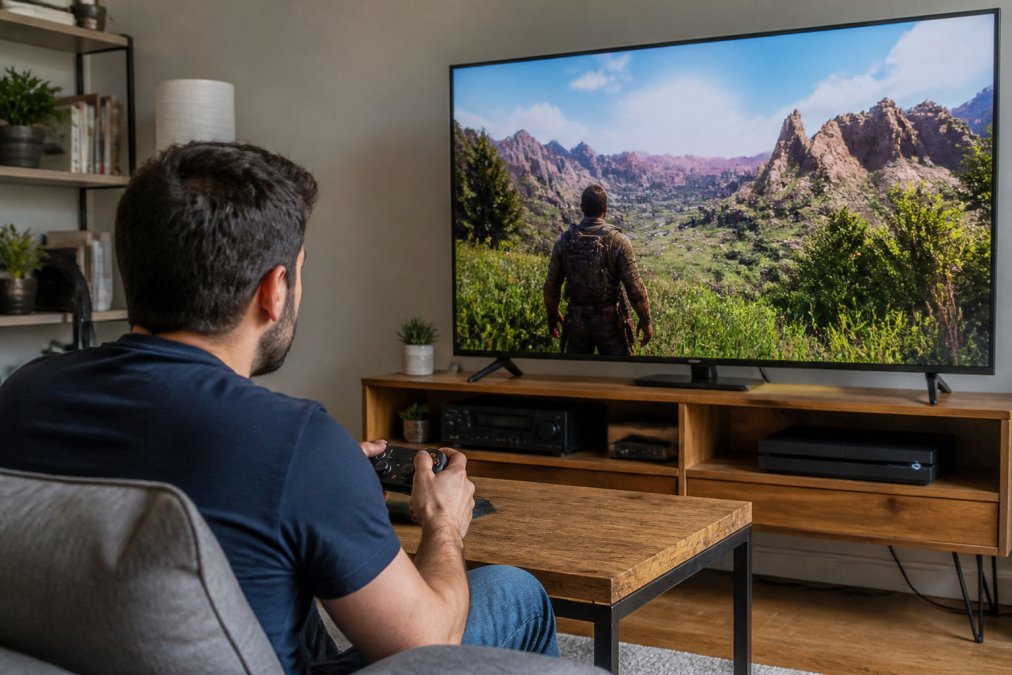
Native 4K vs. Upscaling: What You Actually See
Native 4K means the GPU renders every frame at 3840x2160. Upscaling means the console renders at a lower resolution, often 1440p, then reconstructs to fill the frame. Modern upscaling is good enough that most players cannot tell the difference in motion.
Refresh Rate, VRR, and HDMI 2.1
HDMI 2.1 unlocks 4K at 120Hz, variable refresh rate, and auto low latency mode. Without it, you are capped at 4K 60Hz over HDMI 2.0. VRR smooths frame rate fluctuations, which matters more than peak frame rate for perceived smoothness.
Storage Ceiling and Expansion Path
The spec nobody puts on the box bites in year two. Modern 4K titles routinely install at 100GB or more once you add a 4K texture pack and a day-one patch, so a 1TB drive holds roughly eight to ten before you start deleting.
Power Draw and Long-Term Efficiency
A 4K-capable console pulls meaningfully more watts than a 1080p box, and the gap widens under load. A 4K console idles in the 30-60W range and peaks well north of 150W during a demanding title. If efficiency matters, look for a documented standby mode under 1W and a power supply rated for the load rather than oversized, a cooler console also runs quieter.
Backward Compatibility and Peripheral Carryover
Backward compatibility is not just about playing old discs. It is about whether your existing controller, headset, and steering wheel still work. Most current-generation consoles support the previous generation's first-party controllers, but third-party accessories are hit-or-miss. Racing wheels and flight sticks are the worst offenders, check the manufacturer's compatibility list before assuming your rig carries over.
The Five-Year Test
Run every candidate through this filter: Can it output 4K at 120Hz over HDMI 2.1? Does it hold a stable frame rate floor in performance mode? Can you expand storage with a standard drive? Does it support your existing peripherals? Will it still receive firmware updates in five years? A console that passes all five is future-proof enough.
4K Gaming Monitor vs TV for Consoles: Which Screen Wins?
A 4K gaming monitor wins for input lag and desk setups; a 4K TV wins for HDR brightness and couch play. The right answer depends on where you sit, not which panel costs more.
How to Optimize Console Settings for 4K HDR
Getting 4K HDR right takes about ten minutes and four menu changes. Most consoles ship with defaults tuned for compatibility, not picture quality.
Start with these steps:
- Enable "Enhanced" or "Deep Color" on the TV input
- Set the console output to 4K and match the refresh rate to the panel
- Turn on HDR only if the display supports wide color gamut
- Enable game mode to cut input lag
- Calibrate brightness using the console's built-in HDR test screen
Best HDMI 2.1 Cables for 4K 120Hz Gaming
HDMI 2.1 cables must be certified for 48Gbps to carry 4K at 120Hz with HDR. Anything rated lower will negotiate down to HDMI 2.0 speeds, and you will not see a warning.
Storage, Peripherals, and Power: The Hidden Costs of 4K Gaming
Storage, peripherals, and power are where 4K gaming budgets quietly blow up. Most buying guides stop at the sticker price; the total cost of ownership over three years is the number that actually matters.
Storage Economics: What a 4K Library Really Costs
Modern titles routinely exceed 100GB, and 4K texture packs can add 20-40GB per game on their own. Here is the cost-per-terabyte breakdown most guides skip:
- Internal M.2 NVMe expansion: fastest load times, but the highest cost per terabyte. A 2TB drive typically runs two to three times the price of an equivalent external drive.
- Proprietary expansion cards: convenient, but historically priced at a premium over standard M.2 drives. If the console uses a proprietary format, budget for it up front.
- External USB drives: cheapest per terabyte, but slower load times and often incompatible with current-generation titles that require the internal SSD.
- Hybrid approach: keep current games on the internal drive and archive older titles to an external drive. This is the pattern most long-term owners settle into.
Power Draw: The Bill Nobody Adds Up
A 4K-capable setup pulls more watts than a 1080p one, and the difference compounds over years of ownership. A 4K console idles in the 30-60W range and peaks above 150W under load. Add a 4K TV, a soundbar, and a router, and the living room circuit is doing real work.
Three habits cut the bill without hurting performance:
- Enable the console's energy-saving standby mode, which typically drops idle draw under 1W.
- Turn off instant-on features if you do not use them, they keep the console partially awake.
- Use the TV's auto-off timer so the panel is not running when nobody is watching.
Peripheral Compatibility: Will Your Gear Carry Over?
This is the question buyers ask after the purchase, and the one most guides ignore. Before you buy, check three categories:
- First-party controllers: usually backward compatible with the previous generation. Confirm on the manufacturer's support page.
- Third-party controllers and adapters: hit-or-miss. Adapters exist that let third-party sticks work across systems, but compatibility varies by firmware version.
- Headsets, wheels, and flight sticks: the worst offenders. Racing wheels in particular often require a platform-specific chip, so a wheel that works on one console may not work on another.
Cloud Gaming: The Angle Most Guides Miss
Local hardware is only half the 4K story in 2026. Cloud gaming services now stream at 4K on supported titles, which changes the calculus for buyers who do not want to spend on a flagship console.
Putting the Numbers Together
Add up the console, one storage expansion, a certified HDMI 2.1 cable, and any peripheral adapters you need. That total, not the sticker price, is your real entry cost. Then add the annual electricity difference and any subscription you plan to keep. A console that looks cheap up front can cost more over three years than a pricier machine with cheaper expansion and lower power draw.
Frequently Asked Questions
Which console is best for 4K gaming in 2026?
The best 4K gaming console depends on your priorities. For native 4K and a wide game library, the PlayStation 5 and Xbox Series X are top choices. If you want a budget-friendly entry with access to a large catalog, the Xbox Series S is a solid option, though it targets 1440p upscaled to 4K. For retro and indie 4K gaming, the Intel N100 Game PC Box at $412.99 offers a unique alternative. Consider what games you want to play and your TV's capabilities.
Do I need a 4K gaming monitor or a TV for my console?
Both work, but they serve different needs. A 4K gaming monitor typically offers lower input lag and higher refresh rates, which benefits competitive play. A 4K TV often has better HDR and larger screen sizes for immersive single-player games. When choosing between a 4K gaming monitor vs TV for consoles, check for HDMI 2.1, VRR, and 120Hz support. Your seating distance and room setup also matter. For most living rooms, a TV is more practical.
How do I optimize my console settings for 4K HDR gaming?
First, enable HDMI Ultra HD Deep Color or equivalent on your TV's input. On your console, set resolution to 4K and turn on HDR. Use the console's calibration tool to adjust brightness and contrast. If your TV supports 120Hz, enable performance mode in games. For the best HDMI 2.1 cables for 4K 120Hz gaming, look for certified Ultra High Speed cables. Also, turn on game mode to reduce input lag. These steps ensure you get the most from your 4K display.
What are the key hardware requirements for true 4K gaming on consoles?
True 4K gaming requires a console with a GPU capable of rendering at 3840x2160. Look for support for HDMI 2.1, which allows 4K at 120Hz. Variable refresh rate (VRR) reduces screen tearing. A fast SSD reduces load times. For HDR, your TV must support HDR10 or Dolby Vision. The PlayStation 5 and Xbox Series X meet these requirements. The Xbox Series S targets 1440p but upscales to 4K. Check the spec sheet for GPU compute units and memory bandwidth.
Is it worth upgrading to a mid-generation console refresh for 4K gaming?
If you already own a base PS5 or Xbox Series X, a mid-gen refresh may not be necessary unless you want slightly better ray tracing or higher frame rates. For new buyers, a refresh could offer improved performance. However, the base models still deliver excellent 4K experiences. Consider your budget and whether your TV supports advanced features like 120Hz. If you're happy with your current console, wait for a true next-gen leap.
Picking a 4K setup in 2026 means balancing native rendering, HDMI 2.1 bandwidth, and storage you won't outgrow in six months. The Techie Den stocks the media players, retro consoles, and adapters that cover each of those needs, from the Zidoo Z9X 8K with its included HDMI 2.1 cable to the Haute42 Cosmox Booter X for lag-reduced wireless play. Browse the collection and add to cart with confidence, backed by a 15-day free return window on qualifying gear.


