

Last Updated: November 6, 2026
Quick Summary
Preventing ear infections from swimming with earbuds means keeping your ear canal dry and your buds clean, since trapped moisture, not the earbuds themselves, is what lets bacteria and fungi multiply. Choose waterproof earbuds or earplugs that seal properly, sanitize and fully air-dry your buds after every swim, and gently dry your ears without jamming anything into the canal.
- Earbuds act like a cap on a bottle, keeping sweat and humidity in the canal.
- Rinse silicone tips under a tap for 10 to 15 seconds, never with hot water.
- Wipe the hard shell with a wipe containing at least 60% isopropyl alcohol.
- Air-dry tips and buds for at least 30 minutes before reassembly.
- Deep-clean weekly if you swim three or more times per week.
Table of Contents
- How to Prevent Swimmer's Ear When You Swim With Earbuds
- Can You Get Swimmer's Ear From Wearing Earbuds?
- Step 1: Choose Waterproof Earbuds and Earplugs That Actually Seal
- Step 2: Sanitize and Dry Your Earbuds After Every Swim
- Step 3: Dry Your Ear Canal Without Causing Irritation
- Swimmer's Ear Drops: Prevention vs. Treatment
- How to Relieve Ear Pain After Swimming
- Common Mistakes That Raise Your Infection Risk
- Frequently Asked Questions
How to Prevent Swimmer's Ear When You Swim With Earbuds
Preventing ear infections from swimming with earbuds starts with one truth: the earbuds are not the enemy. Trapped moisture is.
A sealed ear canal is a humid ear canal. Below, we walk through the steps that help keep your ears healthy while you train with music. The payoff is simple: you keep your soundtrack and skip the throbbing pain.
Here is what most guides get wrong. They tell you to stop wearing earbuds entirely. That advice ignores how people actually swim.
Why Trapped Moisture Matters More Than the Earbuds Themselves
Swimmer's ear, known medically as otitis externa, is an infection of the outer ear canal. It develops when water gets trapped behind skin debris or earwax and stays there. Bacteria and fungi need warmth and damp to grow. A plugged ear canal delivers both.
Your earbuds act like a cap on a bottle. They keep pool water out, but they also keep sweat and humidity in. The result is moisture accumulation that lingers long after you towel off.
- Pool water carries pathogens that can seed an infection
- Sweat and body heat raise humidity inside the canal
- Earwax traps water against the skin
- A poor seal lets water in and holds it there
So the goal is not zero earbuds. The goal is a dry canal and a clean bud.
Can You Get Swimmer's Ear From Wearing Earbuds?
Yes, you can develop swimmer's ear from wearing earbuds, but the earbuds are usually a contributing factor rather than the sole cause. The real trigger is moisture that stays in the ear canal.
Novant Health's explanation of why earbuds can raise swimmer's ear risk notes that earbuds can block the ear canal and increase moisture. That is the mechanism to watch.
The risk goes up when you combine earbuds with water. A sweaty gym session, a pool swim, or a shower with buds still in all create the same setup: a warm, wet, closed space.
Earbud Fit vs. Water Seal: Why Loose Buds Leak
Fit decides everything. A loose bud lets water slip past the tip, then traps it against the canal wall. A snug bud with a proper silicone tip forms a better seal and keeps more water out.
But a too-tight fit has its own cost. Pressure sensitivity, skin irritation, and micro-abrasions can follow. Broken skin is an open door for bacterial colonization.
The sweet spot is a soft, flexible tip that seals without pressing hard. If your ears ache after an hour, the fit is wrong.
Step 1: Choose Waterproof Earbuds and Earplugs That Actually Seal
Pick gear rated for water, not just sweat. Check the manufacturer's stated water-resistance rating before you swim with any pair.
For earplugs, custom-fitted swim molds beat generic foam. They match your canal shape and hold a seal through turns and flip kicks. A snug bathing cap over the top adds another layer.
If you want a deeper comparison of water-ready audio gear, our guide to durable waterproof earphones for sports breaks down IP ratings side by side. Swimmers who train hard can also read our notes on durable waterproof earphones for active fitness.
When you are ready to buy, browse the Bluetooth 5.3 ear-hook headphones with a secure hook that stays put through laps. Prefer noise cancelling for the gym? The HIFI bass ear-hook earbuds offer another sealed-fit option.


Step 2: Sanitize and Dry Your Earbuds After Every Swim
Clean your earbuds after every single swim. Skip this and you press bacteria straight back into your ear on the next session. Below is a sanitization routine you can run in a few minutes.
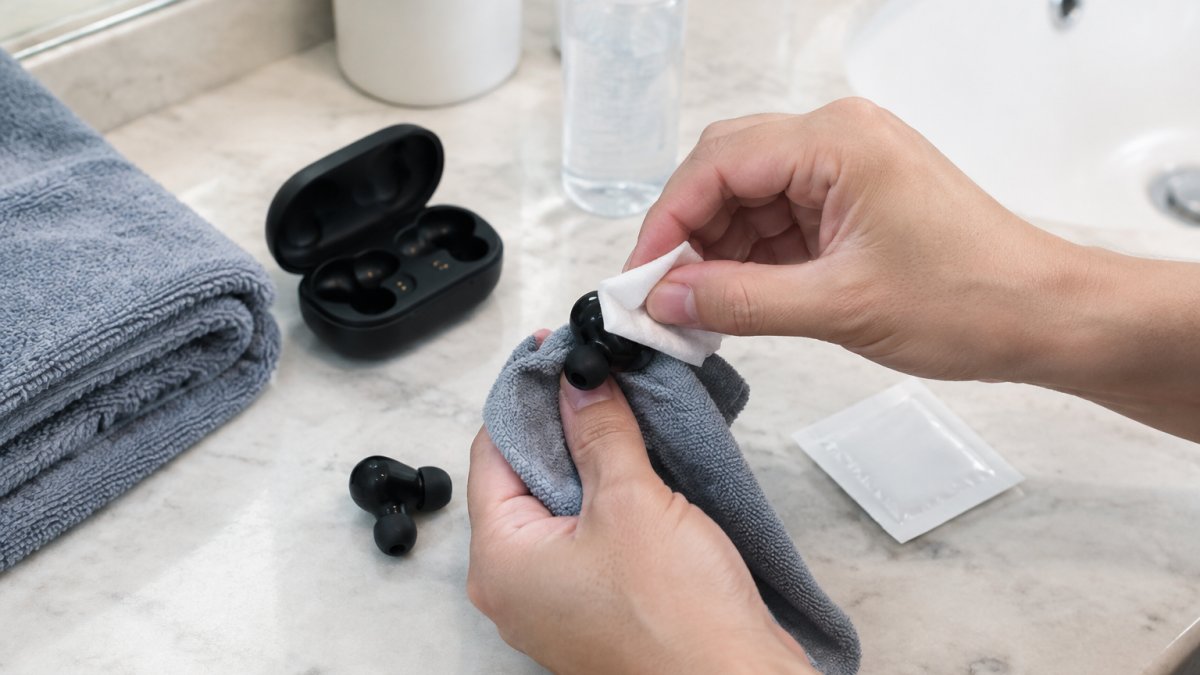
The Post-Swim Sanitization Protocol
- Remove the tips. Pull silicone or foam tips off the nozzles. Tips trap water against the mesh and are the highest-risk surface for bacterial transfer.
- Rinse the tips with fresh water. Hold them under a tap for 10-15 seconds. Do not use hot water, which can warp silicone and degrade foam. Shake off excess and set them aside.
- Wipe the buds with a microfiber cloth. Pull off chlorine, salt, and sweat before they dry into a film. A dry cloth first prevents diluting the disinfectant you use next.
- Disinfect the outer shell. Use a wipe that contains at least 60% isopropyl alcohol, or a 70% isopropyl alcohol wipe. Wring it so it is damp, not dripping, and wipe the housing, buttons, and charging contacts. Never let liquid enter the mesh, the microphone port, or the charging case contacts.
- Clean the mesh, not with liquid. Use a dry, soft-bristled brush (a clean toothbrush works) to lift earwax and debris from the nozzle mesh. Do not poke the mesh with pins or toothpicks; you can tear it and open a path for water.
- Air-dry everything fully. Set tips and buds on a clean towel in a ventilated spot for at least 30 minutes before reassembly. Do not use a hair dryer on the buds; heat can damage the battery and seals.
- Store in a ventilated case. Leave the case open or use a case with a mesh vent. A sealed case traps humidity and creates a fungal incubator.
Watch out: alcohol wipes are for the hard shell only. Alcohol can degrade silicone tips over time and strip the coating on foam tips, so keep wipes off the tips and use fresh water there instead.
How Often to Deep-Clean
A quick rinse-and-wipe after every swim is the baseline. A deeper clean, including tip removal and mesh brushing, should happen at least once a week if you swim three or more times per week. If you notice a film, a smell, or itching after sessions, deep-clean immediately rather than waiting for the weekly slot.
What Not to Use
- Bleach or harsh household cleaners: they can corrode contacts and leave residue that irritates skin.
- Soap and water soaks: soap residue in the nozzle mesh can foam into the ear canal and cause irritation.
- Ultrasonic cleaners: many waterproof earbuds have sealed meshes that can be damaged by cavitation; check the manufacturer's guidance first.
- Shared towels or cloths: use a clean microfiber cloth per session to avoid transferring bacteria from a gym bag.
If your current pair is hard to clean, our earbuds collection includes models with removable tips that make this routine quick.
Run this quick routine after every swim to keep bacteria out of your ears.
| Step | What to do | Key detail |
|---|---|---|
| Remove tips | Pull silicone or foam tips off nozzles | Tips are highest-risk surface for bacteria |
| Rinse tips | Hold under tap 10-15 seconds | No hot water; shake off excess |
| Wipe buds | Use microfiber cloth | Remove chlorine, salt, sweat before disinfecting |
| Disinfect shell | Wipe with at least 60% isopropyl alcohol | Keep liquid out of mesh and ports |
| Clean mesh | Brush with dry soft-bristled brush | Never poke mesh with pins or toothpicks |
| Air-dry | Ventilated spot at least 30 minutes | No hair dryer on buds |
| Store | Ventilated case, left open | Sealed case traps humidity |
Step 3: Dry Your Ear Canal Without Causing Irritation
Dry your ears gently, and avoid jamming anything inside the canal. Cotton swabs can push wax deeper and scratch the skin. Instead, tip your head to the side and tug the outer ear softly to open the canal.
A hair dryer on the lowest, coolest setting, held a hand's width away, can help evaporate trapped water. Keep it moving. Heat and close contact irritate the skin.
- Tilt and tug to drain standing water
- Use a cool, low airflow from a distance
- Pat the outer ear dry with a clean towel
- Avoid earwax impaction by leaving wax alone
Some swimmers use drying agents. More on that next.
Swimmer's Ear Drops: Prevention vs. Treatment
Prevention drops and treatment drops are not the same thing. Prevention drops and treatment drops are different products with different uses. Ask a pharmacist or physician which, if either, is appropriate for you.
According to the American Academy of Otolaryngology-Head and Neck Surgery Foundation's plain-language summary, doctor-prescribed eardrops may be used shortly before or after swimming, at bedtime, or a mix of those times to help prevent swimmer's ear.
A common mistake is using prevention drops on damaged skin. If your ear hurts or feels raw, alcohol stings and can make irritation worse.
How to Relieve Ear Pain After Swimming
Mild discomfort after a swim often settles once the canal dries.
See a doctor if you notice:
- Pain that gets worse instead of better
- Itching that turns into swelling
- Drainage or a feeling of fullness
- Fever or pain spreading to the jaw
These signs point to an active infection that needs treatment, not home care. Chronic infections can follow if you ignore early symptoms.
Common Mistakes That Raise Your Infection Risk
The biggest mistake is swimming with earbuds and skipping cleanup. Gear left damp and dirty becomes a home for pathogens.
Other frequent errors:
- Wearing buds in the shower or sauna
- Sharing earbuds with a training partner
- Scratching the canal with fingernails or swabs
- Ignoring skin irritation from a tight fit
- Using treatment drops as a substitute for prevention
Abrasive surfaces and rough handling cause micro-abrasions. Those tiny cuts let bacteria settle in.
The pattern is clear: dry ears, clean buds, and a good seal beat any single product. research led by G.
Swimming with earbuds does not have to mean a trip to the doctor. The routine is short: seal well, clean after every swim, and dry your canal gently.
At The Techie Den, we stock waterproof audio gear built for exactly this kind of training.
Frequently Asked Questions
Can you get swimmer's ear from wearing earbuds?
Yes, earbuds can raise the risk, but not because the buds themselves are contaminated. Earbuds can block the ear canal and trap moisture, which creates the warm, damp environment where bacteria and fungi grow. The fix is not to stop using them; it is to make sure they seal properly, clean them after every swim, and dry your ear canal thoroughly. Swimmer's ear, or otitis externa, is an infection of the outer ear canal, so anything that keeps that canal wet for hours is the real problem.
Are there swimmer's ear drops I can use to prevent infection?
Doctor-prescribed eardrops are sometimes used to help prevent swimmer's ear. Follow your doctor's instructions exactly. Over-the-counter alcohol and vinegar drops are common, but skip them if you have a perforated eardrum, ear tubes, or active drainage. Ask a pharmacist or physician before starting any drop routine.
How should you clean earbuds after swimming?
Wipe the earbuds with a soft microfiber cloth first, then use a disinfecting wipe or a cotton swab lightly dampened with isopropyl alcohol on the silicone tips only, never inside the nozzle. Remove the tips if they are detachable and rinse them with fresh water, then let everything air-dry completely before putting the buds back in the case. Skip the case if it is damp; a sealed case holds moisture against the buds and undoes the cleaning. Check your manufacturer's instructions, since some waterproof coatings degrade with repeated alcohol use.
What should you do if your ear hurts after swimming?
Mild soreness that fades within an hour is usually just pressure or water shifting in the canal. Pain that builds, lasts more than a day, or comes with itching, discharge, or muffled hearing points to otitis externa and needs a doctor. Do not swim again until a clinician clears you, and do not poke at the canal with swabs or fingernails, which can cause micro-abrasions that let bacteria in.


