

Table of Contents
- Xbox Series X Hardware Performance and Specifications
- Xbox Series X vs Series S 2026 Comparison
- Xbox Game Pass Value in 2026
- Xbox Series X Hardware Longevity and Future Support
- Total Cost of Ownership and Storage Expansion
- Cloud Gaming vs. Local Hardware Performance
- Is Xbox Series X Worth It for Your Setup?
- Frequently Asked Questions
Last Updated: October 2, 2026
Xbox Series X Hardware Performance and Specifications
The console supports 4K at 120 fps with variable refresh rate technology, near-instant load times via its 1TB SSD, and ray tracing for realistic lighting and reflections.
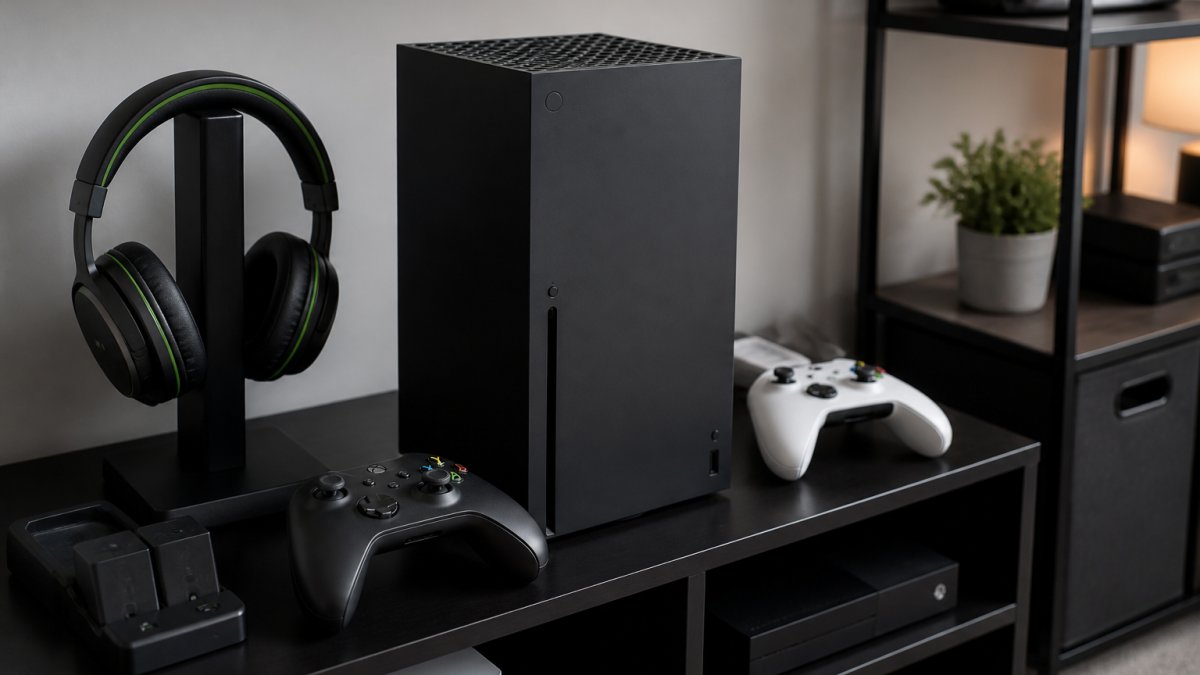
Most games let you choose between Performance mode (60 fps at 4K) and Fidelity mode (higher visual quality at 30 fps).
The thermal management system keeps noise low during extended sessions, and built-in upscaling stretches lower-resolution assets to 4K without visible quality loss.
Xbox Series X vs Series S 2026 Comparison
The Xbox Series X vs Series S 2026 comparison comes down to performance and storage.
Series S includes 512GB storage (half the Series X).
| Feature | Xbox Series X | Xbox Series S |
|---|---|---|
| GPU Performance | 12 teraflops | 10 teraflops |
| Native Resolution | Up to 4K | Up to 1440p |
| Storage | 1TB SSD | 512GB SSD |
| Ray Tracing | Yes | Yes |
| Game Pass Included | 3 months | 3 months |
| Starting Price | Higher | Lower |
For casual gamers on 1440p displays, Series S delivers excellent value. On 55-inch 4K TVs or larger, Series X's extra performance justifies the premium.
The ecosystem and library are identical; your choice depends on display size and storage needs.
Xbox Game Pass Value in 2026
Xbox Game Pass value in 2026 depends on whether you play the rotating library.
Cloud streaming lets you play on phones, tablets, and computers. It works smoothly on 10+ Mbps for story-driven games, though latency affects competitive play.
Game Pass pays for itself if you play 3-4+ new releases yearly (AAA games cost $60-70). Single-franchise players may save money buying standalone.
Xbox Series X Hardware Longevity and Future Support
The Xbox Series X hardware longevity matters because console cycles last 7-8 years.
Games are optimized specifically for this hardware, extracting maximum efficiency from fixed specs, keeping the Series X competitive longer than raw performance suggests.
Cross-generation development is fading by 2026. Most new releases target only Series X and Series S, allowing developers to push hardware harder.
By 2028-2029, a new generation console will likely launch, making Series X the "previous generation" option.
Total Cost of Ownership and Storage Expansion
The total cost of ownership extends beyond the console price. Storage expansion is the largest hidden expense most buyers don't anticipate.
Storage Expansion: The Proprietary Penalty
The Series X ships with 1TB usable storage (802GB after system software), but AAA games consume 100-180GB each. A typical player exhausts capacity within 3-6 months. The proprietary Seagate expansion card costs $219.99 for 1TB, substantially higher than external USB alternatives ($50-80/TB), but is mandatory for current-generation games.
For 4TB total storage (console + two cards), expansion costs $439.98, roughly 24% of the console price. This cost has remained static since 2020.
Storage Scenarios and Long-Term Costs
Light User (4-6 games): 1TB suffices for 12-18 months. Cost: $0.
Moderate User (8-12 games): One expansion card by year 2. Cost: $219.99 (~$55/year).
Heavy User (15+ games): Two cards by year 3. Cost: $439.98 (~$147/year).
Game Pass mitigates storage pressure since you can uninstall and reinstall without losing access. However, if you prefer owning games or maintain a large backwards-compatible library, you'll hit expansion costs sooner.
Electricity Consumption Over Five Years
The Series X draws 150-180W during gameplay and 10-15W in standby. At 2 hours daily gameplay, annual consumption is ~210 kWh, costing ~$33.60/year at $0.16/kWh. Over five years, electricity costs ~$168. In high-rate regions (California $0.22/kWh, Hawaii $0.30+/kWh), five-year costs exceed $300.
True Five-Year Ownership Cost Breakdown
Assuming a moderate user purchasing the Xbox Series X at $499 in 2026:
| Cost Category | Amount |
|---|---|
| Console (Series X) | $499 |
| Game Pass subscription (60 months @ $10.99/month) | $659.40 |
| Storage expansion (1 × 1TB card) | $219.99 |
| Electricity (5 years @ $33.60/year) | $168 |
| Total Five-Year Cost | $1,546.39 |
| Cost Per Month | $25.77 |
This excludes additional controllers ($69.99) or Game Pass Ultimate upgrades ($16.99/month), which shift totals significantly.
Series S reduces this burden, its 512GB and $299 price mean moderate users delay expansion to year 2-3. Factor in not just the $200 price difference but likely expansion costs ($220-440 by year 3).
Cloud Gaming vs. Local Hardware Performance
Cloud gaming vs. local hardware performance is no longer simple in 2026. Xbox Cloud Gaming offers a genuine alternative, but tradeoffs remain significant and genre-dependent.
Gaming Converter for Mayflash Magicboots X One Hitbox Fightbox Adaptador FPS →
Technical Performance: Latency and Bandwidth Requirements
Xbox Cloud Gaming streams from remote servers, introducing round-trip latency of 80-150ms depending on server distance, connection quality, and network congestion.
Competitive gaming requires sub-50ms latency. Fighting games and shooters suffer above 100ms. Story-driven, turn-based, and puzzle games are unaffected by 100-150ms latency.
Bandwidth requirements: 1080p/60fps needs 10-15 Mbps, 1440p/60fps needs 20-25 Mbps, 4K/60fps needs 35+ Mbps. Many "100 Mbps" plans deliver 60-80 Mbps actual throughput due to WiFi interference or ISP throttling, causing compression artifacts at 4K.
Local Hardware Eliminates Variability
The Series X renders locally, eliminating streaming latency and bandwidth constraints. Input latency totals 30-50ms (controller + TV processing), substantially lower than cloud gaming.
This difference is imperceptible for casual play but gives competitive players a measurable advantage. Professional esports players universally use local hardware.
Practical Viability by Game Genre
Story-Driven Games: Cloud gaming is excellent; latency doesn't matter. 25 Mbps delivers smooth 1440p.
Turn-Based Strategy/Puzzle: Cloud gaming is ideal; no real-time reaction needed.
Competitive Multiplayer: Cloud gaming is problematic; 100+ ms latency disadvantages you.
Fighting Games: Cloud gaming is nearly unusable; requires sub-50ms latency. Local hardware mandatory.
Sports Games: Cloud gaming is marginal for online play; local hardware preferred.
Is Local Hardware Still Necessary in 2026?
For story-driven, turn-based, or casual players, cloud gaming via Game Pass Ultimate ($16.99/month) eliminates the $499 console. A $30-50 streaming device suffices.
For competitive multiplayer, fighting games, or latency-sensitive titles, local hardware becomes necessary. Series X provides the performance ceiling without streaming compression or latency.
The hybrid approach is increasingly common in 2026: players own a Series X for competitive and demanding titles but use cloud gaming for casual, story-driven, or turn-based games.
The Real Decision: Console vs. Cloud vs. Hybrid
Buy the Xbox Series X if: You play competitive multiplayer, fighting games, or demanding single-player titles where latency and visual fidelity matter.
Use Cloud Gaming exclusively if: You play primarily story-driven games, turn-based strategy, or casual titles. You have a stable 25+ Mbps internet connection.
For most players buying in 2026, the Series X remains the safer choice because it guarantees performance across all game types.
Is Xbox Series X Worth It for Your Setup?
The question of whether is Xbox Series X worth it breaks down into three scenarios:
Scenario 1: You own a 4K display (55 inches or larger) and play diverse games. The Series X justifies its premium. The performance difference is visible on your screen, and the extra storage prevents constant uninstalls. You'll get 5+ years of strong support. Buy the Series X.
Scenario 3: You're uncertain about commitment or play very casually. Game Pass with cloud streaming on a cheap streaming device lets you test the ecosystem without buying hardware.
The Techie Den recommends pairing either console with quality peripherals to maximize the experience. The Haute42 Cosmox Booter X wireless adapter enables low-latency wireless gameplay with compatible controllers at $72.99, eliminating cable clutter while maintaining responsive input. For precision gaming, the Mchose A7 V2 Pro Ultra tri-mode wireless gaming mouse at $80.99 delivers 42,000 DPI tracking across 2.4GHz wireless, Bluetooth, and wired modes. For fighting game enthusiasts, the Gaming Converter for Mayflash adapters at $71.99 supports arcade stick compatibility across Xbox platforms.


The financial decision ultimately depends on your display, gaming habits, and how long you plan to keep the console.
Consider your total setup cost including a quality display, Game Pass subscription, and storage expansion when making your decision.
Frequently Asked Questions
Can I play Xbox Series X games on an Xbox Series S?
Most Xbox Series X games run on Series S, but with lower resolution and frame rates. Series S targets 1440p at 60fps while Series X delivers 4K at 60fps or higher. Some titles optimize specifically for each console's hardware, so performance varies. Check individual game specifications before purchasing if you're deciding between the two consoles.
How long will Xbox Series X be supported by Microsoft?
Microsoft typically supports hardware for 7-10 years after launch. The Xbox Series X released in November 2020, so expect robust support through 2027-2030. Game Pass continues expanding its library, and backwards compatibility ensures older titles remain playable. However, exclusive new releases will eventually shift focus to future hardware.
What's the real difference between Xbox Series X and PlayStation 5 in 2026?
Both deliver similar raw performance: 4K gaming at 60fps, ray tracing, and fast load times via solid state drives. The key difference is the game library. Xbox Game Pass offers hundreds of titles for one monthly fee, while PlayStation focuses on exclusive franchises. Your choice depends on which exclusive games matter to you and your preferred subscription model.
Is it worth upgrading to Xbox Series X from an older console?
Yes, if you own an Xbox One or earlier. Series X delivers dramatically faster load times, significantly better graphical fidelity, higher frame rates (120fps in some titles), and access to the latest exclusive games. If you're upgrading from PlayStation or PC, consider Game Pass value and the exclusive Xbox titles you want to play before committing.
The Xbox Series X worth it in 2026 if your setup and gaming habits align with its strengths. The Techie Den has helped thousands of gamers build complete setups that maximize their investment. Get started with the right console and accessories from The Techie Den, and you'll have a gaming platform that remains competitive through 2030 with the performance, storage, and ecosystem support that justifies the premium.


