

Table of Contents
- Quick Comparison: Top Wireless Audio Options
- Best Noise-Canceling Headphones for Office Work
- How to Choose Wireless Earbuds for Comfort and Fit
- Wireless Speaker Battery Life Comparison and Longevity
- Sound Quality, Connectivity, and Real-World Performance
- Durability, Maintenance, and Long-Term Ownership
- Conclusion: Choosing Your Daily Wireless Audio
Last Updated: August 15, 2026
Quick Comparison: Top Wireless Audio Options
When you're shopping for best wireless audio for daily use, the choice comes down to what matters most: sound quality, noise cancellation, battery life, comfort, or price. The market has fragmented into three distinct categories: over-ear headphones for office work, true wireless earbuds for mobility and comfort, and portable speakers for flexibility. Each serves different needs. Your choice depends on your primary use case, whether you're commuting, working from home, exercising, or juggling multiple devices throughout your day.
| Product | Type | Price | Battery Life | Key Strength | Best For |
|---|---|---|---|---|---|
| Bluetooth 5.3 Headphones (Ear Hook) | Earbuds | $11.99 | 7 hours | Active noise cancellation + HiFi stereo | Office work, calls |
| T75 Bone Conduction | Earbuds | $3.99 | 5 hours | Lightweight, waterproof design | Sports, outdoor use |
| VAORLO Wireless Earphones | Single Ear | $3.99 | 5 hours (earphone) + 180h standby | Ergonomic ear-hook, low latency | Gaming, long standby |
| Wireless Bluetooth Glasses | Wearable Audio | $47.99 | Extended | Hands-free audio + calling | Multitasking, calls |
Below, we'll break down each category and show you exactly how to evaluate wireless audio for your specific situation, whether you need best noise-canceling headphones for office work, comfort-focused earbuds, or a speaker system that lasts all day.

Best Noise-Canceling Headphones for Office Work
Active noise cancellation transforms how you work in open offices, coffee shops, or shared spaces. The Bluetooth 5.3 Headphones with Ear Hook design deliver this feature at an accessible price point.
The Bluetooth 5.3 Headphones ($11.99) combine active noise cancellation with HiFi stereo sound and a 7-hour battery life on a single charge. The 16mm driver delivers clear mids and treble, while the sealed earcup design provides passive isolation that works even before ANC kicks in. IPX4 waterproof rating handles sweat and spills, important if you're moving between your desk and meetings throughout the day.
What makes these stand out for office work: the ear-hook design prevents fatigue during 8+ hour days. Many office workers discover that over-ear headphones cause discomfort after 4-5 hours of continuous wear. The hook distributes pressure across the ear rather than clamping down on your head. The low-latency codec support means video calls sync properly, no more lip-sync delays during Zoom meetings.
The 200-hour standby time matters more than you'd think. Charge these once on Sunday, and they'll hold a charge through Thursday without touching the case. For someone juggling multiple meetings and focus time, that reliability eliminates the daily charging ritual.
Connectivity spans 10 meters reliably, which covers a typical office floor without dropouts. The voice assistant integration handles hands-free calls and quick commands without removing the headphones.
How to Choose Wireless Earbuds for Comfort and Fit
Comfort determines whether you'll actually wear your earbuds all day or abandon them after two hours. The wrong fit causes ear fatigue, pressure points, and that nagging sensation of something not sitting right.
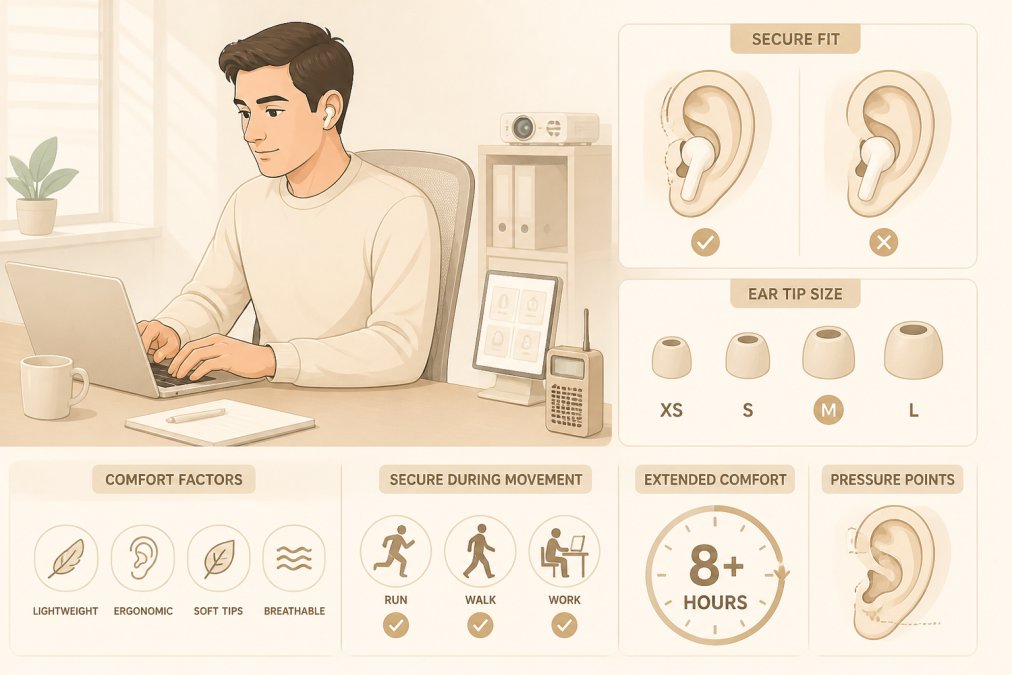
Start by evaluating earcup material and design. Silicone ear-hook designs, like the VAORLO Wireless Bluetooth Earphones ($3.99), distribute weight across multiple contact points rather than relying on a single seal inside your ear canal. This matters for 5+ hour listening sessions. The silicone padding on the VAORLO model conforms to your ear shape, reducing pressure buildup that causes discomfort.

Clamping force, how tightly the earbuds press against your ears, directly affects comfort duration. Lighter clamping means you can wear them longer without fatigue. The VAORLO design uses a 108-degree elevation angle that matches your ear's natural shape, minimizing that "squeezed" feeling. Test this by wearing candidates for 2-3 hours before committing.
Driver size influences both sound and physical comfort. Larger drivers (16-20mm) typically deliver better bass response but can feel bulkier in your ear. The T75 Bone Conduction earphones use a 20mm driver in a semi-open design, meaning sound leaks slightly but your ear canal stays less pressurized. This open design reduces the "plugged ear" sensation that causes discomfort during extended wear.
Fit stability matters if you move between tasks. The VAORLO's ear-hook design prevents falling out during exercise or quick head movements. If you're stationary most of the day, desk work, video calls, a lighter design works fine. If you're moving between meetings, walking, or doing physical work, the hook prevents constant readjustment.
Weight is often overlooked. A 5-gram single earbud feels substantially lighter than a 10-gram model after wearing for hours. The VAORLO weighs 5 grams per ear, which means minimal fatigue during an 8-hour workday. Compare this to heavier over-ear options that can cause neck strain if worn continuously.
Wireless Speaker Battery Life Comparison and Longevity
Battery longevity separates reliable daily-use audio from frustrating devices that need constant charging. Understanding standby time versus active playtime helps you choose audio that fits your actual usage pattern.
The VAORLO Wireless Earphones deliver 180 hours of standby time, meaning the battery holds charge for nearly a week with zero use. This addresses a real frustration: earbuds that sit in your drawer and die before you remember to use them. The 5-hour active playtime covers a typical workday with room to spare.
Compare this to the T75 Bone Conduction earphones (5-hour active playtime, 50mAh battery). The shorter battery reflects the lighter weight and more compact design. For someone who charges every night anyway, the difference is minimal. For someone who charges weekly, the VAORLO's extended standby becomes valuable.

Active playtime varies by usage. At moderate volume (60-70% of maximum), most wireless earbuds exceed their rated playtime by 20-30%. At high volume (85%+), expect 10-15% less runtime. The Bluetooth 5.3 Headphones deliver 7 hours at moderate volume, which translates to roughly 6 hours at high volume.
Charging speed affects daily workflow. The T75 charges in approximately 1 hour from empty. The VAORLO uses cable charging (included) rather than wireless charging, which is faster but less convenient. For office work, faster charging matters less, you're charging overnight anyway. For travel or commuting, slower charging becomes annoying if you need the device during your commute.
Battery degradation happens over time. Lithium-ion batteries (used in all wireless audio) lose roughly 10-15% capacity per year under normal use. Budget for replacement after 2-3 years if you use your earbuds daily. This is why standby time matters, devices that sit unused lose charge more slowly than devices in constant use.
Sound Quality, Connectivity, and Real-World Performance
Sound quality depends on driver size, frequency response, and codec support. The Bluetooth 5.3 Headphones feature 16mm drivers with HiFi stereo tuning, meaning the sound signature emphasizes clarity across the frequency range rather than bass-heavy tuning.

Frequency response describes which pitches the audio reproduces well. Most wireless earbuds claim 20Hz-20kHz range (the theoretical human hearing range). What matters in practice: how well they reproduce speech (500Hz-3kHz) and whether they distort at high volume. The Bluetooth 5.3 Headphones maintain clarity in the midrange, which is where most speech and music detail lives. For office calls and music listening, this matters more than extended bass response.
Bluetooth 5.3 provides multipoint connectivity on supported devices. This means your earbuds can connect to your phone and laptop simultaneously, automatically switching when you take a call on one device. The Bluetooth 5.3 Headphones support this seamlessly. The T75 uses Bluetooth 5.1, which handles dual-device switching but with slight delay (1-2 seconds). For office workers bouncing between laptop calls and phone notifications, Bluetooth 5.3 is noticeably smoother.
Codec support determines compression quality. AAC and SBC codecs (used in the VAORLO model) compress audio more heavily than aptX or LDAC. For office calls and casual listening, the difference is barely perceptible. For music enthusiasts, the compression becomes obvious on dynamic tracks. The Bluetooth 5.3 Headphones use optimized codec handling that adapts to your device's capabilities.
Wireless range in real-world conditions differs from manufacturer specs. The rated 10-meter range assumes line-of-sight in an open space. Through walls, in crowded offices, or near other wireless devices (WiFi, microwaves), expect 5-8 meters of reliable range. All three models handle typical office layouts without dropouts.
Latency, the delay between audio source and playback, matters for video calls and gaming. The VAORLO emphasizes low latency for gaming, making it suitable for someone who plays video games during breaks. The Bluetooth 5.3 Headphones handle standard office use without noticeable lag. For video calls, any latency under 200ms is imperceptible to humans.
Durability, Maintenance, and Long-Term Ownership
Wireless audio devices accumulate earwax, sweat, and dust over time. Maintenance determines whether your $12 earbuds work perfectly for 2 years or fail after 6 months.
IPX4 waterproof rating (on the Bluetooth 5.3 and VAORLO models) means they survive splashes and sweat but shouldn't be submerged. This rating covers office environments and light exercise. If you're swimming or running in heavy rain regularly, you need IPX7 or higher, not available in this price range.
Earcup padding degrades from regular contact with skin oils and sweat. Silicone pads (used on the VAORLO) last longer than foam pads and are easier to clean. Wipe them weekly with a dry cloth, monthly with a slightly damp cloth. Replace pads every 12-18 months if you wear them daily, most manufacturers sell replacement pads for $5-15.
Charging ports accumulate lint and debris. The Bluetooth 5.3 Headphones use USB charging (standard) while the VAORLO uses proprietary cable charging. Standard USB ports are easier to clean and replace if damaged. Proprietary connectors create vendor lock-in but sometimes fit more securely.
Repairability varies by design. The VAORLO's ear-hook design allows individual earbud replacement, if one fails, you can buy just the replacement earbud rather than a full pair. Over-ear designs typically require full replacement if one side fails. For long-term ownership, modular designs reduce waste and cost.
Battery replacement is possible but often requires opening the device. Most wireless earbuds aren't designed for user-replaceable batteries. Plan for device replacement every 2-3 years rather than battery replacement. This is why initial purchase price matters less than durability and support.
Firmware updates extend device lifespan. The Bluetooth 5.3 Headphones support app-based firmware updates that improve connectivity and battery efficiency. Devices without app support miss out on performance improvements released after purchase.
Choosing best wireless audio for daily use means matching your primary use case to the right device. For office work where noise cancellation and call quality matter most, the Bluetooth 5.3 Headphones deliver professional-grade features at an entry-level price. For comfort-focused listening during long workdays, the VAORLO's ergonomic design and extended standby time win. For athletes and outdoor enthusiasts, the T75 Bone Conduction design keeps your ears open to ambient sound while delivering waterproof reliability.
Add your preferred option to your cart today and experience the difference that quality wireless audio brings to your daily routine.
Frequently Asked Questions
What features should I prioritize when choosing wireless audio for daily use?
Focus on active noise cancellation to reduce ambient noise in offices or commutes, battery longevity (aim for 5+ hours minimum per charge), comfortable ergonomic design for extended wear, and reliable Bluetooth 5.2 or 5.3 connectivity. Sound quality matters, but frequency response and driver size directly affect how well audio fidelity meets your needs. For daily use, durability and water resistance ratings protect against sweat and moisture exposure.
How do I choose between wireless earbuds and over-ear headphones for daily tasks?
Earbuds excel for mobility, commuting, and multitasking because they're compact and portable. Over-ear headphones deliver better passive isolation, superior soundstage, and longer battery life, making them ideal for focused office work or creative tasks. Consider your commute length, workspace environment, and whether you need hands-free calls. Many professionals use earbuds for transit and over-ear headphones at their desk for optimal daily audio.
What is the best wireless audio setup for a home office?
A home office benefits most from best noise-canceling headphones for office work paired with a wireless speaker for ambient sound or video calls. Look for headphones with beamforming microphones for clear voice pickup during meetings, at least 7+ hours of battery life, and comfortable ear cup padding for all-day wear. Bluetooth 5.3 ensures stable signal and multipoint connectivity across your laptop, phone, and other devices. The Bluetooth 5.3 Headphones Ear Hook at $11.99 offers 7-hour battery life and active noise cancellation specifically designed for this use case.
How long should a good pair of daily-use wireless headphones last before needing replacement?
Quality wireless audio should last 2-3 years with proper care. Battery longevity typically degrades 10-15% annually, so expect reduced playtime after 18 months. Durability depends on build quality, water resistance rating, and how often you expose them to sweat or moisture. Regular hygiene maintenance (cleaning ear cup padding and drivers) extends lifespan. Products with repairability options and firmware updates tend to remain functional longer, making them better long-term investments than disposable models.
This article was written using GrandRanker


