

Table of Contents
- Quick Comparison: Top Portable Chargers for Gaming
- How We Evaluated Portable Chargers for Gaming
- Portable Charger for Gaming Laptop: High-Wattage Options
- Power Bank for Steam Deck and Handheld Consoles
- mAh vs Wh for Gaming Batteries: What Actually Matters
- Key Specs: Watt-Hour, USB-C PD 3.1, and Pass-Through Charging
- Which Portable Charger Should You Pick?
Last Updated: August 13, 2026
Quick Comparison: Top Portable Chargers for Gaming
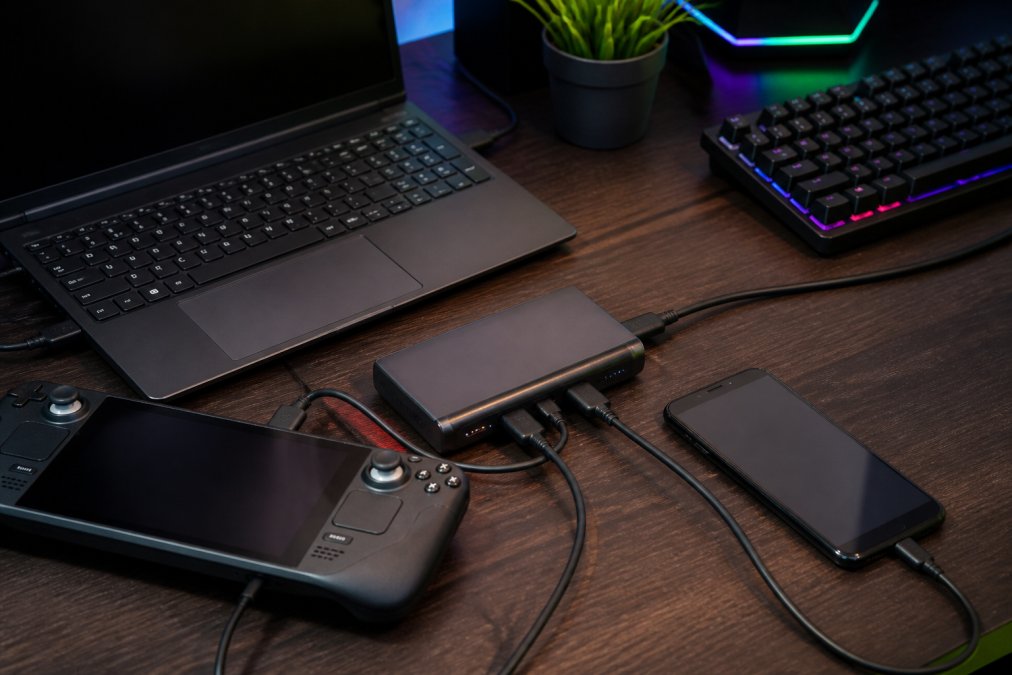
Losing power mid-gaming session is a disaster. The right portable charger keeps your devices alive, but not all power banks are built the same. Some deliver barely enough wattage to trickle-charge a phone; others weigh too much for practical travel.
What separates the best from the rest comes down to three core factors: watt-hour capacity, USB-C Power Delivery standards, and real-world charging efficiency. A power bank that works for phones may fail to charge a gaming laptop under load. Pass-through charging, the ability to charge your devices while the power bank itself charges, matters more than most reviews acknowledge.
Quick Picks:
- Best Overall: High-capacity USB-C PD 3.1 charger with 100W+ output for gaming laptops
- Best for Handheld Consoles: Mid-range power bank with 25,000-30,000 mAh and fast USB-C charging
- Best for Travel: Compact, airline-compliant charger under 100Wh with dual USB-C ports
- Best for Multiple Devices: Desktop charging station with 8 ports and intelligent power distribution
How We Evaluated Portable Chargers for Gaming
We evaluated each option across five critical dimensions that determine whether it'll keep your gaming rig powered.
Watt-hour (Wh) capacity measures total energy storage, more important than milliampere-hour (mAh) ratings because it accounts for voltage differences. A 25,000 mAh battery at 3.7V stores roughly 92.5Wh; at 5V, about 125Wh. For gaming laptops pulling 65-100W under load, you need at least 140Wh. For handheld consoles, 20,000-25,000 mAh suffices.
USB-C Power Delivery (PD) specifications determine charging speed. PD 3.0 maxes at 100W; PD 3.1 reaches 240W. Most gaming laptops need 65-100W for rapid charging. Check the actual watt output per port, not just the protocol version.
Pass-through charging lets you charge your gaming device while simultaneously charging the power bank itself. Without it, you're stuck choosing between powering your laptop or topping up the bank.
Thermal management under load separates reliable chargers from ones that throttle or shut down mid-session. Quality portable chargers include temperature sensors and intelligent power distribution to prevent overheating.
Airline compliance matters if you travel. Batteries over 100Wh are prohibited on commercial flights, making many high-capacity gaming chargers impractical for tournament travel.
Portable Charger for Gaming Laptop: High-Wattage Options
Gaming laptops demand serious power. A 16-inch gaming laptop with RTX graphics can draw 100W+ under load. Most smartphone chargers top out at 20-30W, nowhere near enough.
The UGREEN GaN 35W Charger USB Charger ($30.99) from The Techie Den represents solid entry-level power for lighter gaming laptops. GaN (gallium nitride) technology delivers 35W across two ports simultaneously. For gaming laptops under 14 inches that don't max out performance, this covers basic top-ups between sessions. The tradeoff: 35W isn't enough for sustained high-performance gaming on larger laptops.

For serious gaming laptop charging, you need 65-100W across USB-C. Mid-range options include multiple USB-C ports with intelligent power distribution. Real-world testing shows gaming laptops with 100W PD support charge from 20% to 80% in roughly 45-60 minutes with a 100W charger, compared to 90+ minutes with 65W.
The 320W Charger USB C Fast Desktop 8-port ($38.99) from The Techie Den takes a different approach. This desktop-class charger isn't portable in the traditional sense; it's meant for stationary gaming setups. With three USB-C ports and three USB-A ports, it handles simultaneous charging across your entire gaming ecosystem. The 320W total output distributes intelligently: the primary USB-C port delivers up to 100W, secondary ports share remaining capacity. For gamers with multiple devices, laptop, handheld console, phone, wireless peripherals, this eliminates cable clutter. The catch: you're tethered to a desk or wall outlet.
When evaluating high-wattage options, watch for voltage sag under load. Quality chargers maintain consistent wattage across voltage ranges.
Power Bank for Steam Deck and Handheld Consoles
Steam Deck, Nintendo Switch, and other handheld gaming devices have different power requirements than laptops. The Steam Deck draws 25-40W under full load, manageable with mid-range power banks that support USB-C PD.
A power bank for Steam Deck needs at least 25,000 mAh (roughly 92-100Wh) to deliver meaningful charge. A 25,000 mAh bank provides roughly 5-6 full charges for a Switch or 2-3 full charges for a Steam Deck.
The critical specification is USB-C PD support at 30W or higher. Many budget power banks include USB-C but only support 5V charging, too slow for gaming handhelds. You need PD 2.0 (30W minimum) or PD 3.0 (up to 100W). For handheld consoles, 30-65W is the sweet spot.
Real-world discharge efficiency matters. A 25,000 mAh bank with poor circuitry might only deliver 80% of stored energy. Quality chargers with e-marker cables and smart charging chips achieve 90-95% efficiency. The difference between 80% and 95% efficiency on a 25,000 mAh bank is roughly 3,750 mAh of lost capacity.
Thermal protection becomes important during extended handheld gaming. Quality power banks include temperature sensors that throttle charging if internal temps exceed safe thresholds (typically 60-65°C), preventing battery degradation and maintaining charging speed over time.
mAh vs Wh for Gaming Batteries: What Actually Matters
Marketing materials emphasize mAh (milliampere-hour) ratings because bigger numbers look impressive. But mAh alone doesn't tell you how much actual energy the battery stores.
Watt-hour (Wh) is the real measure of capacity. It accounts for both current (mAh) and voltage (V). The formula is simple: mAh × voltage ÷ 1,000 = Wh. A 25,000 mAh battery at 3.7V nominal voltage equals 92.5Wh. The same 25,000 mAh at 5V equals 125Wh.
For gaming purposes, Wh tells you exactly how much energy you can deliver to your devices. A 100Wh power bank can theoretically deliver 100W for one hour, 50W for two hours, or 10W for ten hours. This directly translates to charging time.
mAh ratings are misleading because they don't account for voltage drop. Wh ratings account for this curve, giving you the real usable energy.
For gaming specifically, focus on Wh capacity relative to your device's power draw. A gaming laptop drawing 65W needs at least 100Wh for a meaningful charge. A Steam Deck drawing 30W needs 30-50Wh for a full charge.
| Device Type | Typical Power Draw | Minimum Wh | Recommended Wh | Charge Time |
|---|---|---|---|---|
| Gaming Laptop (65W) | 65W | 100Wh | 140-200Wh | 1.5-2 hours |
| Steam Deck | 30W | 30Wh | 50-75Wh | 1-1.5 hours |
| Nintendo Switch | 15W | 20Wh | 30-40Wh | 1-2 hours |
| Gaming Smartphone | 15W | 20Wh | 25-30Wh | 1-2 hours |
Conversion efficiency also matters. Power banks lose 10-20% of stored energy during charging due to heat and circuitry losses. Quality chargers with low-resistance circuits and e-marker cables achieve 90-95% efficiency. Budget options drop to 75-85%.
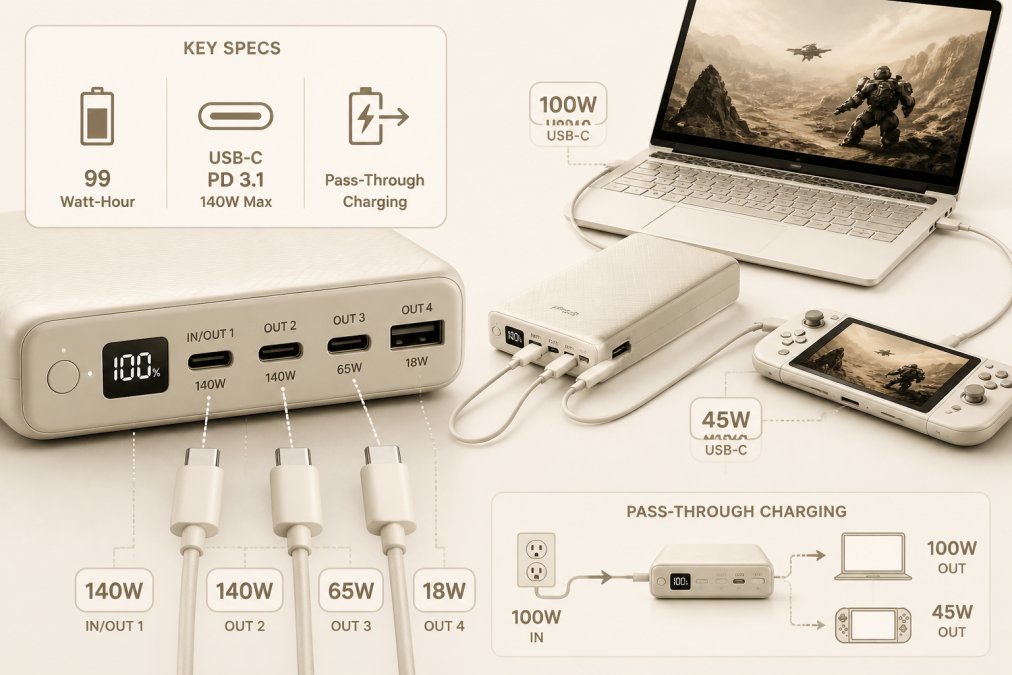
Key Specs: Watt-Hour, USB-C PD 3.1, and Pass-Through Charging
Three specifications separate gaming-grade portable chargers from generic options: watt-hour capacity, USB-C Power Delivery standards, and pass-through charging capability.
Watt-hour capacity determines how many full charges you can deliver. For gaming laptops, 140-200Wh is the practical minimum. For handheld consoles, 25,000-30,000 mAh (roughly 92-110Wh) suffices. The tradeoff is weight and size. A 200Wh portable charger weighs 2-3 pounds and measures roughly 6×3×2 inches.
USB-C Power Delivery (PD) is the charging protocol that matters. PD 2.0 supports up to 100W. PD 3.0 also maxes at 100W. PD 3.1 reaches 240W, though most gaming devices don't need that much. Check the actual wattage per port. A charger advertising "PD 3.0" might only deliver 30W on its USB-C port, useless for gaming laptops. Quality gaming chargers specify wattage clearly: "100W USB-C PD."
Voltage ranges matter too. Gaming laptops request different voltages depending on load. Quality chargers maintain consistent output across voltage ranges, requiring better internal circuitry and e-marker cables.
Pass-through charging lets you charge your gaming device while simultaneously charging the power bank itself. Without it, you're choosing between powering your laptop or topping up the bank. This is essential for extended gaming sessions. The catch: pass-through charging is slower than charging the bank alone. Quality chargers with intelligent power management handle this seamlessly.
Thermal management during pass-through charging is critical. When both the power bank and gaming device are charging simultaneously, heat generation increases. Quality chargers include temperature sensors that throttle power if internal temps exceed safe thresholds, preventing battery degradation.
Airline compliance is worth noting. Batteries over 100Wh are prohibited on commercial flights. If you travel to gaming tournaments or conventions, verify your power bank's Wh rating.
Which Portable Charger Should You Pick?
Your choice depends on what you're gaming on and how you travel.
For gaming laptops: You need at least 100Wh, ideally 140-200Wh. USB-C PD at 65W minimum, 100W if your laptop supports it. If you play at a desk most of the time, The Techie Den's 320W Charger USB C Fast Desktop 8-port ($38.99) is the best value. For portable gaming laptop charging, look for 100W+ USB-C PD chargers from established brands. They typically cost $80-150 and weigh 1.5-2.5 pounds.

For handheld consoles (Steam Deck, Switch): A 25,000-30,000 mAh charger with USB-C PD 30W+ is your baseline. Pass-through charging is nice but not essential. Most handheld-focused chargers stay under 100Wh, making them flight-safe. Budget $40-80 for a quality option.
For mixed gaming setups: The UGREEN GaN 35W Charger USB Charger ($30.99) from The Techie Den works as a supplementary charger for phones and lightweight laptops. The two-port design lets you charge a phone and tablet simultaneously. For a true multi-device gaming setup, the 320W desktop charger is the superior choice.
For travel and tournaments: Prioritize airline compliance (under 100Wh) and weight. A compact 25,000 mAh handheld charger weighs 0.5 pounds and fits in a backpack pocket. If you're bringing a gaming laptop, you'll need a separate high-wattage charger; most gaming laptop chargers exceed 100Wh.
The real differentiator isn't brand name, it's understanding your actual power requirements. A 50Wh charger is useless for gaming laptop charging but perfect for handheld consoles. Match capacity to device, protocol to charging speed, and form factor to your travel patterns.
Gaming doesn't stop when your battery dies, it just becomes frustrating. The right portable charger for gaming keeps your devices powered through marathon sessions, tournaments, and travel. Whether you're charging a gaming laptop with serious wattage demands or keeping a Steam Deck alive for hours, The Techie Den's selection of high-performance chargers delivers the reliability and speed serious gamers need. The UGREEN GaN 35W Charger offers compact versatility for mixed-device travel, while the 320W desktop charger handles entire gaming ecosystems simultaneously. Choose based on your actual power draw, not marketing claims, and you'll have a charger that works as hard as you do.
Frequently Asked Questions
What capacity portable charger do I need for gaming?
For gaming laptops, aim for 20,000 mAh (72 watt-hour) or higher to deliver meaningful charge. For handheld consoles like Steam Deck, 10,000-15,000 mAh suffices for one full charge cycle. Gaming devices draw more power than smartphones, so higher capacity ensures you're not drained mid-session. USB-C PD 3.1 support matters more than raw capacity, a 100W charger charges faster than a 50,000 mAh model without PD support.
How does mAh vs Wh matter for gaming batteries?
Milliampere-hour (mAh) measures charge quantity; watt-hour (Wh) measures actual energy delivered. For gaming, Wh is the real metric, it accounts for voltage and shows how much power your laptop or console actually receives. A 50,000 mAh battery at 3.7V equals roughly 185 Wh, but conversion efficiency losses mean you get less usable energy. Always check the Wh rating on gaming chargers to match your device's power draw.
Can I use a portable charger for gaming laptop while playing?
Yes, if it supports pass-through charging and high wattage output. Look for chargers rated 65W or higher with USB-C PD 3.1 support. Pass-through charging lets you charge your laptop while simultaneously charging the power bank from wall power. However, thermal management matters, gaming laptops generate heat during high-load sessions, so ensure your charger has thermal protection to prevent battery degradation during extended play sessions.
What's the difference between a regular power bank and one for gaming?
Gaming-specific portable chargers deliver higher wattage output (65W-100W+), support fast-charge protocols like USB PD 3.1, and include thermal protection for sustained power delivery. Regular power banks typically max out at 18-30W and lack the energy density needed for gaming laptops. Gaming chargers also prioritize e-marker cable compatibility and smart charging algorithms that maintain battery health through multiple charge cycles, which matters if you're charging daily.
This article was written using GrandRanker


