

Table of Contents
- The Real Cost of a Dead Phone Abroad
- Portable Charger vs. Buying Power on the Go
- TSA Power Bank Regulations: What You Can Actually Pack
- How to Choose a Power Bank for Travel That Fits Your Gear
- Why Charging Port Issues Decide Your Backup Strategy
- The Hidden Risks: Voltage, Grid Variability, and Juice Jacking
- Our Verdict: When a Portable Charger Pays for Itself
- Frequently Asked Questions
Last Updated: September 7, 2026
The Real Cost of a Dead Phone Abroad
A dead phone in a foreign city is a safety issue: you lose maps, reservations, translation apps, and the ability to call for help. For many travelers, the question of whether a portable charger for international travel is worth it gets answered the moment their battery drains below 20% during a layover.
Reliable power is the backbone of mobile connectivity. The short answer is yes, a portable charger is worth it for most international trips, but the type you need depends on your flight duration, device ecosystem, and tolerance for risk.
Below, we break down the math of buying power abroad versus packing it, explain TSA carry-on rules, and show how to match a power bank to your travel style.
Portable Charger vs. Buying Power on the Go
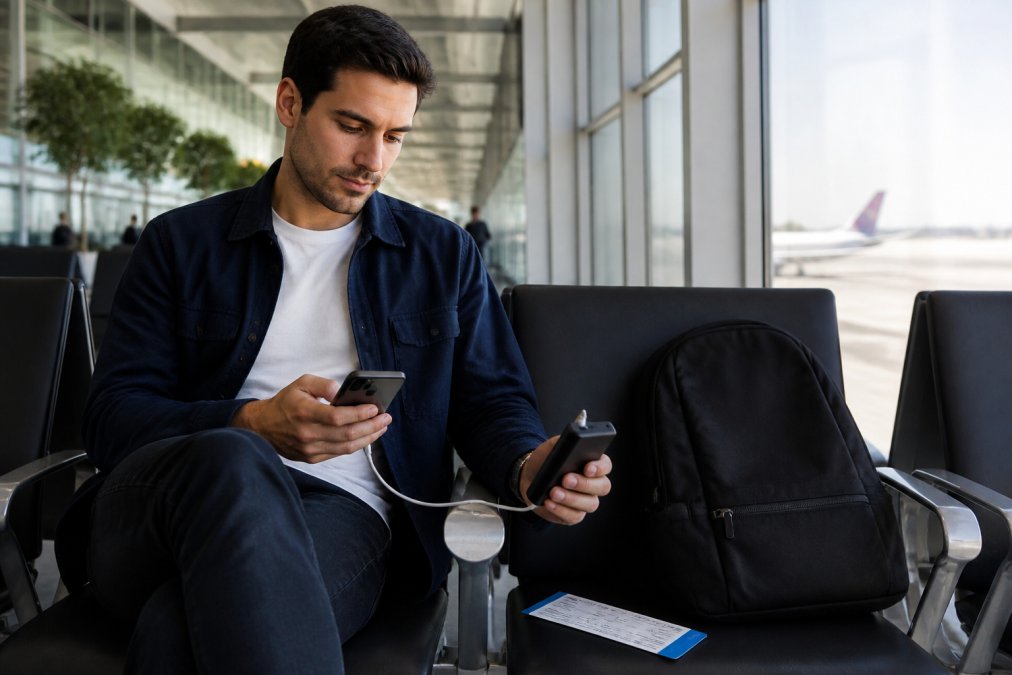
Airport charging stations and rental kiosks are unreliable: outlets are often occupied, lines are long, and kiosks charge a premium for a partially charged battery. A portable charger eliminates that variable, giving you a full reserve of energy before you board.
Renting a battery at an airport kiosk can cost more than owning a dedicated travel charger, and you still have to return it. Buying a cheap power bank from a foreign gift shop often means accepting an uncertified product with questionable safety standards. Packing your own certified unit is cheaper over a week of travel and safer for your devices.
TSA Power Bank Regulations: What You Can Actually Pack
The Transportation Security Administration regulates power banks based on their capacity, measured in watt-hours. Most consumer portable chargers are allowed in carry-on luggage, but they are strictly prohibited in checked bags due to the fire risk posed by lithium-ion batteries. This rule applies consistently across all domestic and international flights departing from US airports.
The TSA limit for carry-on batteries is 100 watt-hours, which covers nearly every consumer power bank on the market. If you carry a larger battery between 100 and 160 watt-hours, you must get airline approval before your flight. Anything above 160 watt-hours is not permitted on passenger aircraft at all. These are the TSA guidelines for lithium-ion batteries that govern what you can physically bring through security.
Watt-Hours vs. Milliamp-Hours: Which Limit Applies to You
Most power banks advertise capacity in milliamp-hours (mAh), but the TSA enforces limits in watt-hours. To convert, multiply the mAh rating by the voltage (usually 3.7V) and divide by 1,000. A 20,000 mAh power bank typically equals 74 watt-hours, clearing the 100 watt-hour limit with room to spare.
A 27,000 mAh unit often exceeds 100 watt-hours, requiring airline approval. For most international travel, a 10,000 to 20,000 mAh power bank provides the best balance of capacity and compliance, enough energy for multiple full phone charges without special permission or the risk of being turned away at the gate.
| Battery Capacity | Typical Watt-Hours | TSA Status | Best For |
|---|---|---|---|
| 5,000 mAh | ~18.5 Wh | Allowed in carry-on | Emergency top-ups |
| 10,000 mAh | ~37 Wh | Allowed in carry-on | Single phone recharge |
| 20,000 mAh | ~74 Wh | Allowed in carry-on | Multi-device travel |
| 27,000 mAh | ~100 Wh | Airline approval needed | Long-haul heavy use |
How to Choose a Power Bank for Travel That Fits Your Gear
Choosing the right power bank for travel starts with an honest inventory of what you carry. A single smartphone needs far less capacity than a phone plus a tablet, earbuds, and a gaming console. Charging speed also matters; a 5W unit will keep your phone alive but takes hours to refill it from empty.
Look for USB-C Power Delivery support. This fast charging standard delivers higher wattage to compatible devices, meaning shorter charge times. A power bank with at least 18W output charges most modern smartphones at full speed, while 45W or higher is necessary for laptops and tablets that support USB-C charging.
Matching Capacity to Your Flight and Layover
For a transatlantic flight of seven hours or more, a 10,000 mAh power bank covers a single phone fully. If you are connecting through multiple airports or spending extended time away from outlets, step up to 20,000 mAh, it handles a phone, earbuds, and a tablet without running dry, and still fits within the TSA's watt-hour limit.
Battery degradation is a real factor in extreme climates. Lithium-ion batteries lose capacity faster in heat, so a power bank left in a hot car or on a sunny beach will hold less charge over time. For tropical destinations, choose a unit with a higher starting capacity to absorb that degradation.
Why Charging Port Issues Decide Your Backup Strategy
The most common travel charging failure is not the battery; it is the port. Loose connections, bent cables, or a damaged charging port can leave you unable to charge even with a full power bank. Testing your cables and ports before departure matters as much as choosing the right capacity.
A reliable wall charger for your hotel room is just as essential as a power bank. The UGREEN GaN 35W Charger USB Charger uses gallium nitride technology to stay compact while delivering 35W, supports USB-C Power Delivery for fast charging of iPhones and Samsung devices, and has dual ports for charging a phone and earbuds simultaneously. It accepts 100-240V input, so it works worldwide with the right plug adapter. You can find this charger at The Techie Den.

Power output matters more than most travelers realize. A charger that supports fast charging protocols will refill your phone in 30 minutes instead of two hours, which makes a meaningful difference during a tight layover. The USB Power Delivery specification defines the fast charging standard that most modern devices rely on for optimal charge speeds.
The Security Angle: Your Power Bank as a Defense Against Juice Jacking
Most travelers don't think of a portable charger as a security tool, but it is one of the most effective ones you can pack. Public USB charging stations, in airport gates, hotel lobbies, and some long-haul flights, are a known vector for 'juice jacking,' where a compromised port can install malware or siphon personal data while your phone appears to charge. The FCC has issued public warnings advising travelers to avoid public USB ports and carry their own chargers and cables.
A power bank completely sidesteps this risk. When you charge from your own battery, you draw power from a device you control, not an unknown port that could be a gateway for malicious software. For travelers who handle sensitive work data or personal financial information, the protective value of a power bank is arguably as important as its ability to keep your screen lit.
Practical Port Protection: Cables, Connectors, and Contingencies
Beyond security, physical port failures are a leading cause of charging problems on the road. A cable that works at home can fail after being coiled tightly in a bag for a 10-hour flight. Pack redundantly and test everything before you leave. Bring at least one spare cable, preferably braided or reinforced. If you use an iPhone, consider an MFi-certified Lightning cable to meet Apple's performance and safety standards.
Another common point of failure is the power bank's own output port. A unit with a single USB-C port used for both input and output can wear out faster than a model with dedicated ports. Choose a travel power bank with at least two output options, such as one USB-C and one USB-A, so you have a backup if one port becomes loose. Also, check that your phone's charging port is clean and free of lint; debris is a frequent cause of intermittent charging mistaken for a dead battery or broken cable.
In humid or dusty destinations, port contacts can corrode more quickly. Keep your charging ports covered when not in use, using the rubber plugs that often come with power banks or a small adhesive port cover. These inexpensive habits prevent the most common charging failures.
The Hidden Risks: Voltage, Grid Variability, and Juice Jacking
International travel introduces power variables that domestic users rarely consider. Wall voltage varies by country, from 100V to 240V. Most modern chargers are dual-voltage and handle this range automatically, but older or cheap chargers may not, leading to failure or device damage.
Regional power grids also fluctuate in stability. In some destinations, voltage spikes and brownouts are common, stressing unprotected electronics. A quality charger with overcharge protection and short-circuit prevention safeguards your devices. Look for certifications like UL and FCC, which indicate the device has been tested for safety and electromagnetic interference.
Grid variability connects directly to your backup strategy. If you are traveling to a region with frequent power outages, a power bank becomes an emergency preparedness tool. A 20,000 mAh unit can keep your phone operational for days of intermittent use, which matters if you need to contact your embassy or arrange transportation during an unexpected disruption.
Regional Power Infrastructure: When a Power Bank Becomes a Lifeline
The need for a portable charger is not uniform across the globe. In countries with highly reliable power grids, such as Japan, South Korea, and much of Western Europe, a power bank is primarily a convenience for long sightseeing days. However, in regions where rolling blackouts are common or rural areas have intermittent electricity, it shifts from a nice-to-have to critical emergency gear. Travelers to parts of Southeast Asia, sub-Saharan Africa, or the Caribbean may encounter scheduled power cuts or voltage fluctuations that can damage unprotected electronics.
A dual-voltage wall charger is the first line of defense, but it only works when the wall outlet has power. A power bank, charged fully at your hotel before a day of exploration, ensures you have a reserve of energy even if the local grid fails. This is particularly important for travelers who rely on their phones for ride-hailing apps, digital maps, or communication with local contacts. In a blackout, a dead battery is not just an inconvenience, it can leave you stranded.
Battery Degradation in Extreme Climates: Heat, Cold, and Performance
Lithium-ion batteries, which power both your phone and your portable charger, are sensitive to temperature extremes. High heat accelerates chemical degradation, permanently reducing capacity. Leaving a power bank in a car dashboard in Phoenix or on a beach towel in the Caribbean can cause noticeable capacity loss after just a few hours. Cold temperatures temporarily reduce a battery's ability to deliver current, which is why phones often shut down in freezing conditions even with a partial charge.
For travelers, this means two things. First, when your itinerary includes extreme climates, choose a power bank with a higher starting capacity than you think you need. A 20,000 mAh unit that might degrade by 10% in tropical heat still has enough reserve to charge your phone multiple times. Second, practice proper battery hygiene: keep your power bank out of direct sunlight, avoid leaving it in a parked car, and in cold destinations, keep it in an inner pocket close to your body to maintain its operating temperature.
The Juice Jacking Threat: A Security Argument for Carrying Your Own Power
Public USB charging stations are a known security risk, yet many travelers still plug in when their battery is low. The FCC has issued explicit warnings about 'juice jacking,' where a compromised port can install malware or steal data. This is not theoretical; security researchers have demonstrated the attack at major conferences, and airports and hotels have been cited as high-risk locations.
A portable charger is the simplest and most effective defense against this threat. When you charge from your own power bank, you draw power from a device you control, not an unknown port that could be a vector for malicious software. For business travelers handling sensitive corporate data or journalists working in unfamiliar environments, this security benefit alone justifies the weight of carrying a power bank.
Our Verdict: When a Portable Charger Pays for Itself
A portable charger pays for itself the first time you avoid the stress of a dying battery in an unfamiliar city. If you travel internationally more than once a year, or rely on your phone for navigation, translation, and boarding passes, the investment is justified. The alternative is gambling on airport outlets and rental kiosks, which fails exactly when you need power most.
For most travelers, a 10,000 to 20,000 mAh power bank with USB-C Power Delivery is the sweet spot. It covers a full day of heavy use, complies with TSA regulations, and fits easily in a day bag. If you also need a hotel-room charger, the UL certification standards for power adapters ensure that products meeting these requirements have passed rigorous safety testing for overcurrent and overheating protection.
For a multi-device setup at home or in a hotel, the 320W Charger USB C Fast Desktop 8-port from The Techie Den handles a phone, laptop, tablet, and accessories simultaneously. It delivers up to 100W through its USB-C port, supports Qualcomm Quick Charge and USB PD protocols, and consolidates all your charging needs into a single desktop unit.

The decision comes down to how much you value reliability. A dead phone abroad can cost you time, money, and peace of mind, all harder to replace than a battery. The Techie Den offers a curated selection of charging solutions designed to elevate your digital lifestyle. Get started with The Techie Den and travel with the confidence that your devices stay powered wherever your itinerary leads.
Frequently Asked Questions
Can I fly internationally with a portable charger?
Yes, but only in your carry-on luggage. The TSA requires all portable chargers and power banks to be packed in carry-on bags, not checked luggage, because they contain lithium-ion batteries. The limit is 100 watt-hours (roughly 27,000mAh) per battery. Anything between 100 and 160 watt-hours needs airline approval. Chargers over 160 watt-hours are banned from passenger aircraft entirely.
Is a 20000mAh power bank allowed on an international flight?
Yes, a 20000mAh power bank is allowed on international flights departing from the US. At typical 3.7-volt output, that capacity equals about 74 watt-hours, which falls under the 100 watt-hour TSA limit. You must keep it in your carry-on luggage and never in your checked bag. This capacity gives you roughly four full phone charges, making it a practical ceiling for most travelers.
What is the best portable charger for international travel?
The best international travel charger combines capacity, portability, and universal compatibility. Look for a 10000mAh to 20000mAh power bank with USB-C Power Delivery for fast charging. For wall charging, the UGREEN GaN 35W Charger USB Charger, available at The Techie Den, handles 100-240V input, so it works with outlets worldwide using a plug adapter. This dual approach covers both in-transit and hotel charging without adding much weight.
How many power banks can I bring on a plane?
The TSA does not set a fixed limit on the number of power banks you can carry, but the total watt-hour rating matters. All batteries must stay under 100 watt-hours each unless you get airline approval for units up to 160 watt-hours. In practice, airlines may cap you at two to three power banks, so check with your carrier before packing multiple spares.


